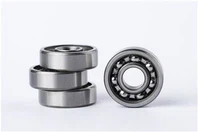
The development of pulley bearings is a fascinating journey that spans thousands of years, evolving from simple mechanical devices to highly sophisticated components used in a wide range of industries. As a leading supplier of pulley bearings, I am excited to share the rich history of these essential parts and their continuous innovation.


Ancient Origins
The concept of using pulleys dates back to ancient times. The earliest known pulleys were simple devices made from wood or stone, used primarily for lifting heavy objects. The ancient Egyptians are believed to have used pulleys in the construction of the pyramids around 2500 BC. These early pulleys were likely fixed, meaning they were attached to a stationary point and used to change the direction of a force. This allowed workers to use their body weight more effectively when pulling ropes to lift large stones.
Around 400 BC, the Greeks made significant advancements in pulley technology. Archimedes, the famous Greek mathematician and inventor, is credited with developing the compound pulley system. A compound pulley combines multiple pulleys to increase mechanical advantage, making it possible to lift much heavier loads with less effort. Archimedes' work laid the foundation for the scientific understanding of pulleys and their applications in various fields.
Middle Ages and the Renaissance
During the Middle Ages, pulley technology continued to develop, although at a slower pace compared to the ancient period. Pulleys were widely used in agriculture, mining, and construction. In the mining industry, for example, pulleys were used to hoist ore and equipment from deep underground mines. These pulleys were often made of wood or metal and were relatively simple in design.
The Renaissance period saw a resurgence of interest in science and technology, leading to further improvements in pulley bearings. Engineers and inventors began to focus on reducing friction in pulley systems to increase efficiency. They experimented with different materials and lubricants to make the movement of pulleys smoother. The use of ball bearings in pulley systems was also introduced during this time. Ball bearings consist of small metal balls that roll between two surfaces, reducing friction and allowing for more efficient rotation.
Industrial Revolution
The Industrial Revolution in the 18th and 19th centuries was a turning point in the history of pulley bearings. With the advent of steam power and the mass production of machinery, the demand for high - performance pulley bearings skyrocketed. Factories needed reliable and efficient pulley systems to transfer power from steam engines to various machines on the factory floor.
The development of new manufacturing techniques, such as precision machining, allowed for the production of more accurate and durable pulley bearings. Steel became the material of choice for pulley bearings due to its high strength and wear resistance. The use of roller bearings, which consist of cylindrical rollers instead of balls, also became more common. Roller bearings can handle heavier loads and are more suitable for high - speed applications, making them ideal for industrial machinery.
During this period, many large - scale industries, such as textile, automotive, and manufacturing, relied heavily on pulley bearings. For example, in the textile industry, pulley systems were used to drive spinning and weaving machines, ensuring smooth and continuous production.
Modern Era
In the 20th century, the development of pulley bearings entered a new era of innovation. The introduction of synthetic materials, such as polymers and ceramics, opened up new possibilities for pulley bearing design. These materials offer unique properties, such as high corrosion resistance, low friction, and lightweight, which are beneficial in many applications.
Advancements in computer - aided design (CAD) and manufacturing (CAM) technologies have also revolutionized the production of pulley bearings. Engineers can now design highly complex and optimized pulley bearing geometries using CAD software, and then manufacture them with extreme precision using CAM machines. This has led to the development of pulley bearings with even higher performance, reliability, and durability.
Today, pulley bearings are used in a vast array of industries, from aerospace and automotive to consumer electronics and medical devices. For example, in the aerospace industry, pulley bearings are used in aircraft control systems to ensure smooth and precise movement. In the automotive industry, they are used in engines, transmissions, and accessory drive systems.
Types of Pulley Bearings and Their Applications
As a pulley bearings supplier, we offer a wide range of products to meet the diverse needs of our customers. Some of the popular types of pulley bearings include:
- Door Bearing Wheels: These are commonly used in sliding doors, garage doors, and other applications where smooth and easy movement is required. You can find more information about our Door Bearing Wheels.
- U Type Groove Pulley: U type groove pulleys are designed to hold ropes or belts securely in place. They are often used in conveyor systems, lifting equipment, and other applications where reliable power transmission is essential. Check out our U Type Groove Pulley for more details.
- Industrial Roller Bearings: Industrial roller bearings are heavy - duty bearings that can handle large radial and axial loads. They are widely used in industrial machinery, such as motors, pumps, and generators. Learn more about our Industrial Roller Bearings.
Conclusion
The history of pulley bearings development is a story of continuous innovation and adaptation. From the simple wooden pulleys of ancient Egypt to the high - tech ceramic and polymer bearings of today, pulley bearings have come a long way. As technology continues to advance, we can expect to see even more exciting developments in the field of pulley bearings.
If you are in the market for high - quality pulley bearings, we invite you to contact us for a consultation. Our team of experts is ready to help you find the right pulley bearings for your specific application. Whether you are a small - scale manufacturer or a large - scale industrial enterprise, we have the products and expertise to meet your needs. Let's work together to ensure the smooth and efficient operation of your machinery.
References
- Dowson, D. (1998). History of Tribology. Professional Engineering Publishing.
- Cardullo, F. (2002). Pulleys and Gears: How Machines Work. Heinemann Library.
- Rothbart, H. A., & Brown, T. H. (2005). Mechanical Design and Systems Handbook. McGraw - Hill.