


MINITURE BEARINGS
What is Miniature Bearings?
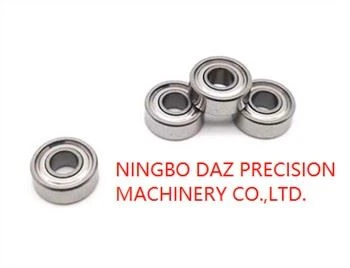
What exactly is a miniature bearing? It comes down to size. Generally speaking, it’s one with an outside diameter less than ½”, and a bore size as small as .0250”. They are available in both metric and imperial dimensions. It’s interesting to note that the smallest ones are so tiny and precise, they still need to be assembled by hand! Miniature bearings are available in both radial and angular configurations.
High precision
Due to the use of high-quality materials and advanced manufacturing processes, its dimensional accuracy and surface quality can reach a high level. Miniature bearings made of stainless steel can guarantee long-term operation in the temperature range of -40°c to 150°c without rusting; miniature bearings made of ceramics can be used at high temperatures above 200°c without deformation, etc.
Long life
Due to the use of high-quality materials and advanced manufacturing processes, its service life can reach than 1 billion times and its reliability is extremely high (the wear rate is less than 0.1%).
High-speed rotation
Because of its small size and light weight, it does not generate additional dynamic and static loads during rotation; therefore it can be used in high-speed rotation applications.
-
![Smart Fascia Gun Miniature Roller Bearing]()
Smart Fascia Gun Miniature Roller Bearing
During the 2017 NBA Finals, Cavaliers guard Kyrie Irving used a smart fascia gun to relax his backAdd to Inquiry -
![Zirconia Ceramic Balls And Silicon Nitride Balls]()
Zirconia Ceramic Balls And Silicon Nitride Balls
skating shoes bearings with zirconia ceramic balls and silicon nitride ballsThis material of ballAdd to Inquiry -
![Electric Nail Drill Machine Bearing MR128ZZ -ball Bearing 8x12x3.5mm]()
Electric Nail Drill Machine Bearing MR128ZZ -ball Bearing...
HANDLE BEARING FOR DRILL BRUSHNAIL POLISH ELECTRIC MACHINE USED MINIATURE BALL BEARINGSAdd to Inquiry -
![625ZZ --Low Noise High Speed Miniature Bearing/Auto Parts]()
625ZZ --Low Noise High Speed Miniature Bearing/Auto Parts
625ZZ --Low Noise High Speed Miniature Bearing/Auto PartsWidely used in window slider 、shower doorAdd to Inquiry -
![Miniature Ball Bearing 699ZZ]()
Miniature Ball Bearing 699ZZ
Cage (namely, bearing cage, also known as bearing retainer), refers to a bearing part thatAdd to Inquiry -
![Very Small Ball Bearings]()
Very Small Ball Bearings
Customized bearing, customer special drawing accepted and to be designed separatelyAdd to Inquiry -
![Miniature V Groove Bearings]()
Miniature V Groove Bearings
Customized bearing, customer special drawing accepted and to be designed separately.Add to Inquiry -
![608 Roller Bearing]()
608 Roller Bearing
All products on line are 100% inspected and would have been strictly checked in house beforeAdd to Inquiry -
![Mini Roller Bearings]()
Mini Roller Bearings
All products on line are 100% inspected and would have been strictly checked in house beforeAdd to Inquiry -
![Micro Roller Bearings]()
Micro Roller Bearings
MR63ZZ Shielded Ball Bearing 3mm x 6mm x 2.5mm, the bore size is 3mm, outer diameter is 6mm andAdd to Inquiry




Why Choose Us
Our factory
The company mainly produces ball bearings made of miniature gcr15 steel as raw materials and carbon steel. Bearings, plastic-coated bearings, etc. The bearings produced by the company are widely used in micro motors, mobile doors and windows, and mobile two-wheeled trams.
Production equipment
Grinding equipment, cleaning equipment, automatic riveting and pressing equipment, automatic inspection equipment-s0910 and bvt all-in-one machine.
Production market
The current market is mainly in the middle east, europe, america, southeast asia, etc. Our company's matching motorcycle accessories for the southeast asian market have received a good response.
Our service
Provide pre-sales technical consultation, drawing design and other services, from customer consultation, order placement, tracking production, shipment declaration and a series of related 7/24 hours services, follow-up service tracking to customer feedback on products used.
Miniature deep groove ball bearings
Deep groove ball bearings are a widely used type of miniature bearings. They have the characteristics of simple structure, easy manufacturing and installation, long service life, and are suitable for working under high-speed conditions. Deep groove ball bearings can withstand radial and axial loads.
Miniature angular contact ball bearings
Miniature angular contact ball bearings can withstand radial and axial loads. Compared with deep groove ball bearings, angular contact ball bearings have a relatively larger rated load capacity. This bearing is widely used in equipment such as cnc machine tools and high-speed power tools because it is suitable for high-speed rotation and high-precision requirements.
Miniature tapered roller bearings
Miniature tapered roller bearings are the type of bearings that mainly bear radial and axial loads. Its inner and outer conical surfaces are both inclined surfaces. This inclined surface prevents the bearing from deflecting when bearing radial and axial loads. Miniature tapered roller bearings are widely used in heavy machinery and metallurgical equipment and other fields.
Miniature self-aligning ball bearings
Miniature self-aligning ball bearings can produce a certain deflection angle in the bearing and mainly bear large radial loads and certain axial loads. Aligning ball bearings are suitable for vibration and impact load applications, such as steel manufacturing equipment, agricultural machinery and equipment, etc.
Miniature thrust ball bearing
Miniature thrust ball bearing is a special separable ball bearing, consisting of a shaft washer, a seat washer and a steel ball with a cage. Usually the material of the two washers and balls is chromium steel, and the material of the cage is brass or stainless steel. If longer corrosion resistance is required, stainless steel thrust bearings are a good choice, with both washers, balls and cages made of stainless steel (ss440). Miniature thrust ball bearings with hybrid ceramic balls are also very popular.
Materials Used in Miniature Bearings
Stainless steel
Is the most popular material today. In the united states, 440c is the preferred variety. Stainless steel bearings are hardened to a higher level, allowing for higher speeds and load ratings. They also provide excellent longevity and corrosion resistance, making them ideal for medical and dental applications. In fact, any use where the bearing could be exposed to the elements would benefit from stainless steel. Interestingly, overseas manufacturers tend to select 400 series steel, which is a little softer.
52100c chrome steel
For less threatening environments, 52100c chrome steel will get the job done at a better price point than stainless. It’s also softer than 440c, and therefore easier to machine. It’s ideal for light duty, moderate speed applications such as vacuum motors. Lower speed applications include computer fans and atm printers. These are just a few of many products that use chrome steel miniature bearings.


Ceramic
Ceramic hybrid bearings are widely used in electric motors, aerospace applications, performance racing vehicles, laboratory equipment, underwater applications and more. Any application that requires higher speeds, lower friction and longer life are ideal for ceramic hybrid bearings. Ceramic bearings are becoming more popular today due to their favorable characteristics. They are extremely lightweight, practically impervious to the elements, and boast a much longer lifespan than metallic ones. But for certain applications, such as mission and safety critical ones in military and aerospace, reliability and longevity are much bigger factors than price tag. Another benefit is that they handle high speeds extremely well with very little.
Beryllium copper
This material was somewhat popular in the past, but is becoming obsolete. The biggest benefits are its ability to conduct electricity, along with good strength and hardness. However, when producing becu bearings, a toxic gas is emitted. The risks and associated costs to process them has grown significantly over the years, making them more impractical to produce.
Application of Miniature Bearings
Electronics
Miniature Bearings Play a vital role in various electronic devices such as hard disk drives, printers, and more. They are used to support components like optical lenses, fans, and robotic arms, ensuring smooth operation of the equipment.
Precision instruments
Miniature Bearings Are critical in precision instruments and experimental equipment. For example, they are applied in optical instruments, laser devices, , measurement instruments, etc., to achieve precise motion control and positioning requirements.
Model making
Miniature Bearings Are commonly used in model making projects, including model airplanes, ships, trains, etc. They ensure smooth movement of model components, providing a more realistic and fluid operating experience.
Mechanical equipment
Miniature Bearings Are widely used in various mechanical equipment, such as small power tools, automation equipment, and more. They ensure high-speed operation and stability of the equipment, enhancing production efficiency.
Factors for Choosing Miniature Bearings
Choosing the right miniature bearing for your application is critical to ensuring optimal performance and reliability. There are many factors that need to be considered when selecting miniature bearings to avoid selection errors.
Determine application requirements for bearings
Before selecting a miniature bearing, it is important to understand the bearing requirements of the application, including load, speed, accuracy and operating environment. Determining this information will help you narrow your choices and select a bearing that meets the requirements of your specific application.
Choose the right bearing type
After determining the application requirements, select the appropriate bearing type. For example, if the application requires high precision, angular contact bearings may be one of the best choices. If the application requires high-speed performance, deep groove ball bearings or ceramic bearings may be a better choice.
Consider bearing materials
Bearing material affects bearing performance and durability. Stainless steel bearings are ideal for applications in harsh environments, while ceramic bearings offer high stiffness, low friction, wear and corrosion resistance. However, ceramic bearings are also generally expensive.
Miniature bearing accuracy
In most cases rolling bearings of normal dimensions and rotational accuracy are sufficient. When requirements are higher, bearings require higher accuracy levels. According to the international organization for standardization (iso) definition, precision bearings are classified into grades p0, p6, p5, p4 and p2. These classes are defined based on the maximum allowable deviation of the inner and outer raceways and rolling elements.
Micro bearing speed
Single-row bearings have particularly low friction and therefore can reach the highest speeds. Such bearings include deep groove ball bearings that can only bear radial loads and angular contact ball bearings that can bear combined loads. Improving the dimensional accuracy, rotational accuracy and mating part accuracy of the bearing, adopting advanced lubrication and cooling methods, and using special forms of cages can all increase the allowable speed of the bearing. Low-noise operation, small motors, office equipment and household appliances generally require low operating noise.
Miniature bearing stiffness
The stiffness of a bearing usually refers to the force required to produce a certain elastic deformation of the bearing. The bearings on the machine tool spindle and pinion shaft require high stiffness. Due to the different contact conditions between rolling elements and raceways, the stiffness of roller bearings is higher than that of ball bearings.
How to Maintain Miniature Bearings


Proper handling and storage
They should be handled and stored properly to keep moisture, dust, or dirt from entering the bearings. First, miniature bearings should be kept horizontally in their original packaging in a clean, dry area at room temperature.
When miniature bearings are handled without reason, like when their wrappings are taken off too soon, corrosion or other problems can happen. Miniature bearings are small, fragile parts that need to be handled with care. So, parts that have been dropped shouldn't be used since that could cause them to break down too soon.
Regular inspection of the shaft and housing
Regular inspections of the shaft and housing ensure that the miniature bearings is good enough to work. Wipe the surfaces clean with a soft cloth and make sure to get rid of any nicks or sharp edges.
Proper mounting
You should mount your miniature bearings correctly, depending on the bearing and how it fits. Depending on the type of load, the speed, and the amount of vibration, radial ball bearing rings can be mounted in several ways, from a loose slide fit to a tight press fit.
The rolling elements could be damaged if you put pressure on the wrong ring when putting something together. You should also avoid fits that are too tight or loose, a bad finish on the bearing seats, and shafts or housings that are not round.
Choose your replacement carefully
When a miniature bearings has reached the end of its useful life, you should replace it with one of the same quality or better quality than the original. A low-quality alternative is more likely to break and could cause more expensive equipment to break down in the long run.
Corrosion prevention
When water or humidity sits on miniature bearings for a long time, rust and corrosion can happen. When this happens, the bearings will wear out faster than they should, which will hurt your performance and productivity. Then, that will make your operating costs go up. When working with miniature bearings, you should always wear gloves.
Call in the experts
Lastly, if you are not sure, ask an expert. A miniature bearings specialist can tell you the best way to take care of your bearings and help you figure out the problem if there is one. It can be as easy as sending the problematic bearings to a professional who will look at them and lubricate them if necessary.

Miniature bearings are characterized by their compact size, lightweight construction, high speed capability, and high precision. They are typically made of metal, and consist of rolling elements (usually steel balls or cylindrical rollers) along with outer and inner rings. These rolling elements are distributed between the inner and outer rings to minimize friction while providing support and positioning. The geometric shape and precision of the rolling elements and ring components are crucial for ensuring proper functioning of miniature bearings.
Certifications

Video
FAQ
Q: What is a micro bearing?
Q: What size are miniature ball bearings?
Q: How are miniature ball bearings made?
Q: What are miniature bearings used for?
Q: Where are miniature ball bearings used?
Q: What are the features of miniature bearings?
Q: What are the four requirements of a miniature bearings material?
Q: What are the ideal requirements of miniature bearings?
Q: What is the most important requirement of a miniature bearings?
Q: What is the important requirement of miniature bearings?
Q: What are the physics behind miniature bearings?
Q: What makes miniature bearings faster?
Q: How do you identify miniature bearings?
Q: How do you identify a miniature bearings by size?
Q: What is the most common miniature bearings size?
Q: What is minimum load factor for miniature bearings?
Q: What is the most important part of miniature bearings maintenance?
Q: Are miniature bearings magnetic?
Q: Why are miniature bearings magnetic?
Q: Are bigger miniature bearings better?
As one of the most professional miniature bearings manufacturers and suppliers in China, we're featured by quality products and low price. Please rest assured to wholesale cheap miniature bearings made in China here and get pricelist from our factory. Contact us for customized service.
Stainless Ball Bearings, ball bearing sliding door rollers, 1 7 16 flange bearing