


SELF-LUBRICATION BEARINGS
Self-lubricating bearing
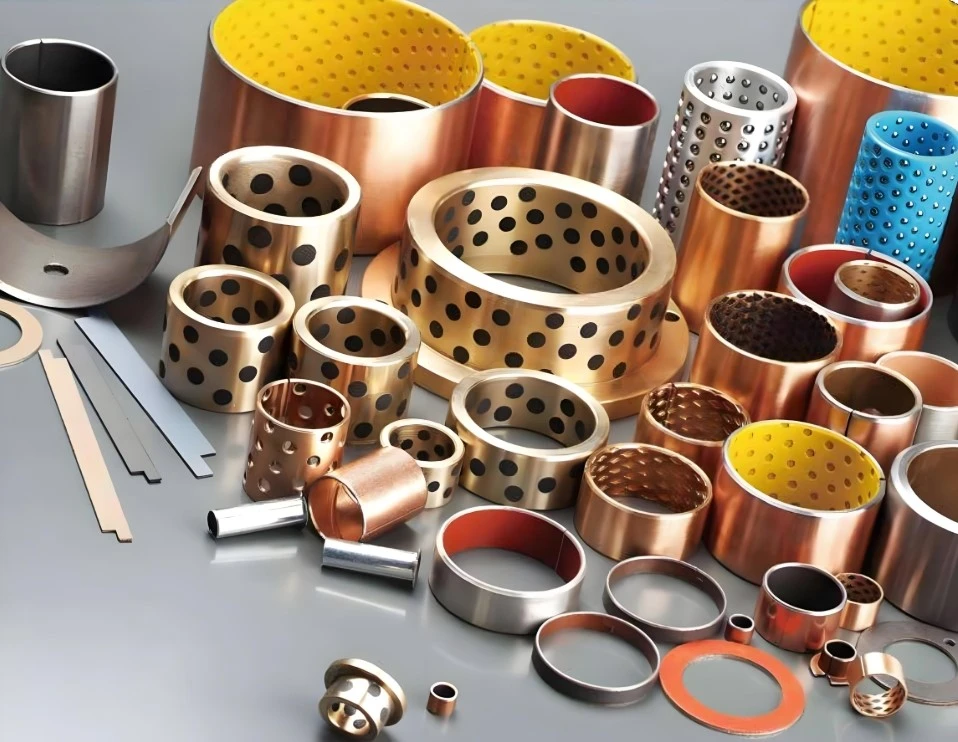
What's Self-lubricating bearing?
Self-lubricating bearings are mechanical parts that use solid lubricating materials to achieve oil-free or oil-less lubrication. They mainly include four categories: composite materials, solid inlays, bimetal materials and special materials. It carries the load through the metal matrix, and the solid lubricant forms a transfer film to reduce friction. It has the characteristics of good wear resistance, low friction coefficient and similar static and dynamic friction coefficients, high load-bearing capacity, thin wall and lightweight. The grinding shaft has low hardness requirements, which reduces the difficulty of processing. The back of the steel can be electroplated with a variety of metals to adapt to corrosive environments and reduce mechanical vibration and noise.
Classification of self-lubricating bearings


Application
Main application areas of self-lubricating bearings

Automotive Industry:
The automotive industry is one of the largest application areas for self-lubricating bearings because they can adapt to stringent requirements such as high temperature, high load, and maintenance-free.
◦ Chassis:Universal joints, tie rod ball joints, suspension system connection points.
◦ Engine system: Tensioner arm, throttle linkage.
◦ Gearbox and braking system: Shift fork, brake pedal bushing.
◦ Body and interior: Examples: door hinges, seat adjustment mechanisms.
Aerospace applications
This is the area with the highest requirements for reliability and lightweight.
◦ Aircraft control systems (such as ailerons and rudder hinges), landing gear systems, and engine accessory mechanisms.
Once these parts fail, the consequences will be disastrous, and maintenance cannot be carried out in the air. Self-lubricating bearings have become the first choice for key components due to their extremely high reliability and lightweight advantages.


Industrial Machinery and Automation
◦ Injection molding machine and die casting machine: Mold clamping mechanism, injection platform guide rail.
◦ Metallurgical and continuous casting equipment: Sectors of continuous casting machines, guide devices of steel rolling equipment.
◦ Mining and construction machinery:Bucket attachment points for excavators, vibrating screens for crushers.
◦ Food and packaging machinery: Conveyor belt bearings and cam followers for filling machines and sealing machines.To prevent lubricating oil from contaminating food, self-lubricating bearings that meet food safety standards must be used (usually using PTFE or special polymer bushings)
Application in marine equipment field
◦Propulsion system: stern bearings (stern tube bearings), controllable pitch propeller (CPP) hub bearings, shaftless pump-jet thruster support/thrust bearings viverra .
◦Deck machinery and steering gear system :Steering gear, deck machinery, flight control system (such as high-speed catamaran)
◦Engine and transmission system:Engine bearings (especially in tilted positions), thrust bearings (absorb propeller thrust)


Renewable energy Application
◦ Wind power generation, yaw and pitch system pads, brake pads, reducer bearings,Yaw system reducer output shaft.
◦ Solar power generation, turning node of photovoltaic/photothermal tracking system .
◦ Hydroelectric power generation, shaft sleeve of water guide mechanism of hydraulic turbine .
Medical devices Apprication
◦ Precision instruments and diagnostic equipment
The moving parts of an MRI (magnetic resonance) scanner. In a strong magnetic field environment, metal bearings will be magnetized and lubricating oil may interfere with imaging, while self-lubricating bearings based on engineering plastics (such as PEEK, PI) are not affected at all.
Ensures clean, oil-free and high-precision operation


Application in railway transportation field
◦ Bogies and running parts, train supports (such as bolsters, suspension seats, etc.)
◦ Shock absorber attachment points and torsion bars for train bogies.
Provide high-performance and low-maintenance solutions
◦ Connection part Coupler system, joint connection part
Application in railway transportation field
Excellent Wear Resistance and Low Friction
Self-lubricating Mechanism: Solid lubricants (such as PTFE, graphite, and molybdenum disulfide) are pre-incorporated into the bearing material, or a transfer film is formed on the friction surface. This ensures that lubricant remains on the friction surface throughout the bearing's service life, significantly reducing wear and extending life.
Extremely High Load Capacity
Metal-based and steel-backed composite self-lubricating bearings, in particular, feature a metal matrix that can withstand extremely high static and dynamic loads, making them suitable for heavy-duty applications.
Excellent Corrosion Resistance
Polymer-based and carbon-based self-lubricating bearings offer excellent resistance to most chemicals, acids, bases, and solvents, making them ideal for use in corrosive environments.
True maintenance-free operation reduces maintenance costs
This is one of their most significant advantages. They require no periodic relubrication, eliminating the costs of lubricating oil, lubrication equipment, labor, and downtime. They are particularly suitable for applications where access is difficult or maintenance costs are extremely high.
Simplified Design and Lightweighting
Because complex lubrication lines and sealing systems are not required, equipment designs can be simpler and more compact. Furthermore, the inherent lightness of polymer-based bearings contributes to overall lightweighting.
Highly Cost-Effective
While some high-performance self-lubricating bearings may have a higher initial purchase cost, their maintenance-free and long lifespan often result in better economics over the entire lifecycle.
Wide Temperature Range
Self-lubricating bearings made of various materials can operate over a wide temperature range. For example, carbon-based bearings can operate at temperatures exceeding 500°C, while certain engineering plastics are suitable for low-temperature environments.
Adaptability to Harsh Environments
They operate effectively in extreme environments such as vacuum, high dust levels, humidity (including underwater), and strong radiation, where traditional liquid lubricants may fail, become contaminated, or degrade.
Clean and Pollution-Free
Because they do not use grease, they avoid contamination of products (such as food, pharmaceuticals, and textiles) and the environment caused by lubricant leaks or splashes, meeting clean production requirements.
Impact Resistance and Vibration Absorption
Many self-lubricating materials (such as polymers) have excellent toughness and vibration absorption capabilities, effectively cushioning impact loads and reducing operating noise.
Excellent Dry-Run Start Performance
At the moment of equipment startup, self-lubricating bearings provide immediate lubrication, even without an oil film, reducing wear during startup. This is superior to traditional bearings that require an oil film to build up.
Analysis table of types, characteristics, advantages and application fields of self-lubricating bearings
| Bearing Type | Key Features | Advantages | Applications |
| Polymer-based self-lubricating bearings (Such as: PTFE/polyoxymethylene POM/nylon PA bearings) |
• Based on engineering plastics or plastic alloys. • Usually embedded or mixed with solid lubricants (such as PTFE, graphite, MoS₂). • Light weight and excellent corrosion resistance. • Quiet operation and good vibration absorption. • The temperature resistance is relatively poor and the load-bearing capacity is limited. |
• Excellent corrosion resistance: Resistant to corrosion by a variety of chemical media. • Oil-free self-lubricating: low friction coefficient in dry state, achieving true oil-free lubrication. • Low cost: raw material and manufacturing costs are relatively low. •Maintenance-free: No need to refuel, reducing maintenance costs. • Lightweight: The density is much lower than metal. |
• Food and beverage machinery, packaging machinery (hygiene, corrosion resistance). • Office equipment, household appliances (such as washing machines, air conditioner swing mechanisms). • Chemical machinery, textile machinery. • Low-load rocking, sliding parts. |
| Metal-based self-lubricating bearings (Such as: copper-based/iron-based powder metallurgy bearings) |
• Using powder metallurgy technology, metal powder (bronze, iron) and solid lubricant (graphite, PTFE) are mixed and sintered. • The matrix provides mechanical strength and the lubricant forms a transfer film during friction. •High load-bearing capacity and good thermal conductivity. •Usually designed with an oil-containing structure (lubricating oil + solid lubricant) |
• High load-bearing and impact resistance: The metal matrix gives it high mechanical strength. • Good thermal conductivity: can dissipate heat quickly. • Both oil lubrication and solid lubrication: oil lubrication in the early stage, solid lubrication in the later stage, and long service life. • Wide operating temperature range: superior to polymer-based bearings. |
• Automotive industry: chassis, suspension systems, gearboxes, door hinges (most widely used). • Engineering machinery: joint joints of excavators and loaders. •Agricultural machinery: parts with high load and lots of dust. • All kinds of high-load, medium and low-speed rotation, swaying sports occasions. |
| Composite self-lubricating bearings (eg: steel back-polymer bushing) |
• Three-layer construction: steel backing (provides strength and stiffness) + porous bronze sintered layer (conducts heat, binds media) + PTFE/polymer friction layer (provides low friction surface). • Combines the high strength of metal with the low friction properties of polymer. |
• Extremely high load-bearing capacity: The steel back can withstand high static and dynamic loads. • Extremely low friction coefficient: The PTFE composite layer provides excellent self-lubricating properties. •Excellent wear resistance: long service life. • Wide range of application conditions: able to adapt to boundary lubrication and even dry friction conditions. |
• Heavy industry: guide sleeves for hydraulic cylinders, automobile steering systems. • Aerospace: flight control systems, landing gear. • High-performance industrial robots: spherical bearings. • It is an alternative to traditional needle roller bearings, especially for oscillating movements. |
| Carbon-based self-lubricating bearings (e.g. graphite/carbon graphite bearings) |
•Based on carbon or graphite, the material itself has solid lubrication properties. • It has the characteristics of self-lubricating, high temperature resistance and chemical corrosion resistance. • The texture is brittle and has poor impact resistance. |
• High temperature resistance: Can work in high temperature environments above 400°C. • Excellent chemical inertness: resistant to almost all organic solvents and corrosive media. •Good electrical/thermal conductivity. • Good dimensional stability: low thermal expansion coefficient. |
• High temperature environment: conveying rollers of metallurgical furnaces and heat treatment equipment. • Chemical pumps and centrifuges (corrosion-resistant, solvent-resistant). • Dry running pump, mechanical seal ring. • Brushes and sliding contacts of electrical equipment. |
| Solid inlaid self-lubricating bearings | • Holes are drilled into a metal matrix (e.g. bronze, cast iron) and a solid lubricant (graphite, PTFE, MoS₂) is embedded in them. • During the friction process, the embedded lubricant forms a continuous and uniform solid lubricating film on the friction surface. |
• Suitable for extreme working conditions: high load, low speed, reciprocating swing, high temperature, vacuum or situations where it is difficult to form an oil film. • Extremely long service life: The lubricant is gradually released, providing an extremely long wear life. • Virtually maintenance-free. |
• Hydraulic gates and turbines (underwater or sediment environment). • Mining machinery (high load, impact, dust). • Injection molding machine clamping mechanism. • Aerospace, vacuum equipment. |
-
![SOLID-SELF-LUBRICATION BUSHES-JSL L SHAPE GUIDE RAIL BEARINGS]()
SOLID-SELF-LUBRICATION BUSHES-JSL L SHAPE GUIDE RAIL BEAR...
SOLID-SELF-LUBRICATION BUSHES-JSL series JSL self-lubricating bearings are a type of wear-resistantAdd to Inquiry -
![SOLID-SELF-LUBRICATION BUSHES-JSP WEAR PLATE]()
SOLID-SELF-LUBRICATION BUSHES-JSP WEAR PLATE
SOLID-SELF-LUBRICATION BUSHES-JSP WEAR PLATE Working Principle and Features The core of JSPAdd to Inquiry -
![SOLID-SELF-LUBRICATION BUSHES-JFFB SERIES HAIF-BUSHES]()
SOLID-SELF-LUBRICATION BUSHES-JFFB SERIES HAIF-BUSHES
JFFB -Half-bushes (double flange ) standard metric size Unit: mmAdd to Inquiry -
![SOLID-SELF-LUBRICATION ---JTW METRIC THRUST WASHER]()
SOLID-SELF-LUBRICATION ---JTW METRIC THRUST WASHER
SELF LUBRICATION BEARINGS-JTW WASHER Washer standard metric size Unit: mmAdd to Inquiry -
![SELF LUBRICATION BEARINGS-JDBS SPHERICAL PLAIN BEARAINGS]()
SELF LUBRICATION BEARINGS-JDBS SPHERICAL PLAIN BEARAINGS
JDBS SPHERICAL PLAIN BEARAINGS spherical plain bearings stand size Unit:mmAdd to Inquiry -
![SELF-LUBRICATION BEARINGS-JFB SERIES FLANGE BUSHES]()
SELF-LUBRICATION BEARINGS-JFB SERIES FLANGE BUSHES
JFB :Flang bearings standard metric size Unit :mm jFFB Double flange bearings standard metric sizeAdd to Inquiry -
![SOLID-SELF-LUBRICATION BUSHES -JDB-CYLINDRICAL BEARINGS]()
SOLID-SELF-LUBRICATION BUSHES -JDB-CYLINDRICAL BEARINGS
SELF-LUBRICATION BEARINGS -JDB SERIES Introduction The solid-inlaid copper-graphite bearing (JDB)Add to Inquiry -
![STEEL-BASED COPPER ALLOY INLAID SOLID LUBRICATE BEARINGS]()
STEEL-BASED COPPER ALLOY INLAID SOLID LUBRICATE BEARINGS
Steel-based copper alloy bearings inlaid with solid lubricants are high-performance bearings with aAdd to Inquiry


As one of the most professional self-lubrication bearings------11111 manufacturers and suppliers in China, we're featured by quality products and low price. Please rest assured to wholesale cheap self-lubrication bearings------11111 made in China here and get pricelist from our factory. Contact us for customized service.
