


SPHERICAL ROLLER BEARINGS
What is a spherical roller bearing?
The spherical roller bearing has double-row rollers, the outer ring has a common spherical raceway (the center of the spherical radius coincides with the center of the bearing), and the inner ring has two raceways that are inclined at an angle relative to the bearing axis. The roller is drum-shaped (spherical end surface) and can adjust the angle between the inner and outer rings adaptively. The characteristics of this structure make it have automatic self-aligning performance, so it is not easily affected by the angle between the shaft and the bearing box seat or the shaft bending, and is suitable for occasions where the angle error is caused by installation error or shaft deflection. In addition to being able to withstand radial loads, this bearing can also withstand bidirectional axial loads.
Production process of spherical roller bearings

1
Raw material preparation
Steel selection: Mainly use high-purity, high-carbon chromium bearing steel (such as GCr15/52100, SAE 52100), requiring extremely low impurity (non-metallic inclusions) content and uniform carbide distribution. The inner ring, outer ring, roller and cage may use different grades or specifications of steel.
Cutting: Cutting rods or tubes into rings (for turning rings) and bars (for rollers) according to the required size

2
Turning
Rough turning of rings: Preliminary turning of the ring material to remove most of the excess and form the basic shape of the ring (inner and outer diameters, end faces, preliminary groove profile). Usually a CNC lathe or automatic lathe is used.
Finish turning of rings: More precise turning is performed to achieve a shape close to the final size, leaving accurate machining allowances for subsequent heat treatment and grinding. Key dimensions include groove position, rib height, etc.

3
Heat Treatment
This is the core process that determines the performance and life of the bearing.
Quenching: Heat the turned ring and roller blanks to above the critical temperature (usually about 830-860°C) to make the structure completely austenitized, and then quickly cool (quench) in an oil or salt bath to obtain a high-hardness martensitic structure.
Tempering: Reheat the quenched parts to a relatively low temperature (usually 150-180°C), keep them warm for a period of time, and then cool them. The purpose is to eliminate quenching stress, improve toughness, stabilize the structure and size, and achieve the required hardness and mechanical properties (ring and roller hardness usually requires HRC 58-64).
Note: It is crucial to strictly control the heating temperature, holding time, cooling rate, and atmosphere (to prevent decarburization and oxidation). Commonly used equipment includes mesh belt furnace, roller hearth furnace, multi-purpose furnace, etc.

4
Grinding
This is a key process to obtain the final high-precision size and shape.
End grinding: First, the two end faces are ground flat to provide a precise reference for subsequent grinding.
OD/ID grinding: Grind the outer diameter of the outer ring and the inner diameter of the inner ring to the precise size and roundness requirements.
Raceway grinding: This is the most critical grinding process for spherical roller bearings.
Outer ring raceway: Grind the spherical outer raceway. A special CNC grinder is required, and the grinding wheel shape and dressing, as well as the machine tool motion trajectory, must be precisely controlled to obtain the precise spherical profile and position.
Inner ring raceway: Grind two symmetrical (usually) logarithmic profile raceways. A high-precision CNC grinder is also required.
Rib grinding: Grind the ribs (guide rollers) on both sides of the inner ring to ensure their angle, height and surface finish.
Roller grinding: Grind the heat-treated roller blank into the final spherical profile (with symmetrical spherical end faces at both ends). A high-precision roller grinder is required.

5
Superfinishing / Honing
Purpose: On the basis of grinding, further improve the geometric accuracy (roundness, waviness) of the working surface of the raceway and roller, reduce the surface roughness (Ra value can reach below 0.05 microns), and improve the surface micro-morphology (form a cross-net pattern that is conducive to the formation of oil film).
Process: Use fine-grained oilstone to perform micro-cutting and polishing on the raceway and roller surface under low pressure and high frequency vibration.
Effect: Significantly reduce the vibration noise of the bearing, and improve the rotation accuracy and fatigue life.

6
Cage Manufacturing
Materials: Stamped steel (common), machined brass, polymer (nylon, PEEK, etc.).
Process:
Stamped steel cage: Steel plate stamping → Forming → Shaping → Deburring → Surface treatment (such as phosphating, galvanizing).
Machined brass cage: Bar turning → Drilling (pocket hole) → Deburring → Cleaning.
Polymer cage: Injection molding → De-gating → Inspection.

7
Assembly
Cleaning: Thoroughly clean all parts (rings, rollers, and cages) to remove contaminants such as grinding residue and anti-rust oil.
Sorting/Matching: Precisely group or match the inner and outer ring raceways based on actual dimensions and roller size to achieve the required radial clearance.
Assembly: Assemble the inner ring, rollers (usually guided and separated by the cage), and outer ring. For spherical roller bearings, assembly requires skill and specialized tooling, especially when inserting the rollers.
Riveting/Locking: For cages secured with rivets or circlips, riveting or installing locking devices ensures the cage does not fall out during bearing operation.
Clearance Testing: Spot-check or fully inspect the assembled bearings to ensure the radial clearance meets standard requirements.

8
Cleaning & Rust Prevention
Final Cleaning: Remove any impurities and oil that may have been generated during assembly.
Drying: Thoroughly dry the bearings.
Rust Prevention: Apply anti-rust oil or grease to prevent rust during storage and transportation.

9
Quality Inspection & Packaging
Comprehensive Inspection: Finished bearings undergo rigorous testing, typically including:
Dimensional Accuracy: Inside diameter, outside diameter, width, assembly height, radial clearance, etc.
Rotational Accuracy: Radial runout and axial runout.
Rotational Flexibility: Checks for smooth rotation and any sticking or noise.
Appearance Quality: Surface defects (scratches, bumps, rust, etc.).
Vibration and Noise: Specialized instruments are used to measure the vibration acceleration (or speed) and noise level of the rotating bearing.

*
Special Requests
Special requirements: such as cleanliness (for specific applications) and residual magnetism.
Marking: Model, brand, production batch number, and other information are engraved or laser-marked on the bearings.
Packaging: Based on customer requirements and shipping methods, appropriate packaging materials (inner packaging such as rust-proof paper or plastic film; outer packaging such as paper boxes or wooden crates) are used to ensure protection from damage and contamination during transportation.
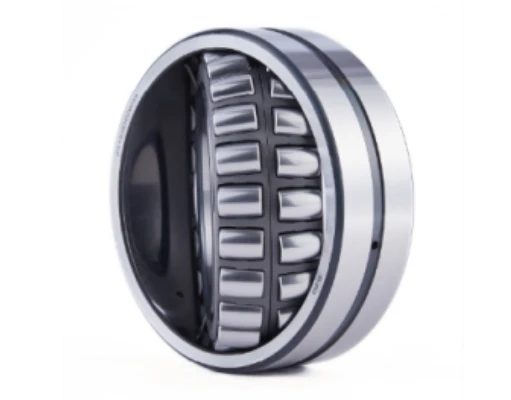


Structure and working principle: core design of automatic centering
The core structure of a spherical roller bearing consists of a double-raceway inner ring, a spherical outer ring, and drum-shaped rollers. The center of curvature of the outer ring raceway coincides with the center of the bearing, forming a unique spherical geometry. When the shaft or bearing seat bends due to load (e.g., deflection ≤ 2.5°), the inner ring can deflect with the shaft, while the rollers adaptively adjust their angles within the outer ring spherical raceway to avoid stress concentration.
Drum rollers:
Increase contact area with the raceway, improving radial load capacity.
Optimized cages:
Available in stamped steel (high rigidity), copper alloy (high-temperature resistance), or nylon (noise and friction reduction). For example, high-speed rail bearings use glass fiber-reinforced nylon cages, offering both strength and safety.
Internal bore variations:
Cylindrical bores accommodate standard shafts, while tapered bores (1:12 or 1:30 tapers) accommodate adapter sleeves, simplifying installation and allowing for clearance adjustment.
Advantages and limitations

Excellent self-aligning capability: Tolerates shaft misalignment of 1°–2.5°, resolving misalignment issues caused by installation errors, long shaft deflection, or foundation settlement, and preventing bearing seizure.
High load-bearing capacity: The drum roller design significantly increases radial load capacity compared to ball bearings, while also withstanding bidirectional axial loads. This makes it particularly suitable for impact load scenarios such as mining crushers and rolling mills.
Low maintenance costs: The split design (such as the US ICAN product) allows for direct replacement in complex locations, eliminating complete machine disassembly and reducing downtime.
Speed Limitation: Due to the large mass and high inertia of the rollers, they tend to heat up at high speeds, resulting in a conventional design with a maximum speed of approximately 600 rpm. Improvements such as CA-type copper cage bearings can increase speeds, but they are still lower than cylindrical roller bearings.
Precision Compromise: Axial play can be caused by limited self-alignment, which can easily lead to roll neck wear and uneven finished product thickness in precision applications such as rolling mills.
Weak Axial Load Bearing: Relying primarily on radial loads, the bidirectional axial load capacity is only 20–40% of the radial load capacity, requiring the use of thrust bearings.

Application Areas
Heavy industry and resource extraction
Mining machinery: Crusher and vibrating screens operate in dusty environments for extended periods, relying on their self-aligning capabilities to compensate for shaft deformation and withstand ore impact loads.
Metallurgical rolling mills: Early rolling mill roll necks used double-row self-aligning bearings, but these were gradually replaced by four-row cylindrical bearings due to their limited precision. However, they are still used in areas not directly involved in rolling, such as gearbox bearing seats.
Specialized Equipment and Emerging Fields
Papermaking Machinery: Dryer cylinder bearings expand and bend easily due to heat, and the self-aligning function ensures continuous production.
High-speed Rail Bearings: Sealed spherical roller bearings utilize labyrinth seals and nylon cages to address the grease leakage and noise issues of traditional designs, while also preventing "hot-scaling" accidents caused by cage breakage
Wind Power and Large Pumps: Long main shaft systems utilize self-aligning capabilities to accommodate wind load deflection, reducing support structure processing costs.
-
![CA-CC-MB TYPE SPHERICAL ROLLER BEARINGS]()
CA-CC-MB TYPE SPHERICAL ROLLER BEARINGS
High speed, low noise, long life, spherical roller bearings CC type, CA type, MB type of 21300Add to Inquiry

As one of the most professional spherical roller bearings manufacturers and suppliers in China, we're featured by quality products and low price. Please rest assured to wholesale cheap spherical roller bearings made in China here and get pricelist from our factory. Contact us for customized service.
