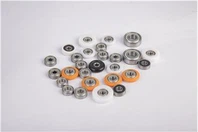
As a supplier of small bearings, one of the most frequently asked questions I encounter is about the friction coefficient of small bearings. Understanding the friction coefficient is crucial for various applications, as it directly impacts the performance, efficiency, and lifespan of the bearings. In this blog post, I'll delve into what the friction coefficient of small bearings is, factors that affect it, and why it matters in real - world scenarios.
What is the Friction Coefficient?
The friction coefficient is a dimensionless quantity that represents the ratio of the frictional force between two surfaces in contact to the normal force pressing the two surfaces together. In the context of small bearings, it describes how easily the bearing components, such as the balls or rollers and the raceways, can move relative to each other. A lower friction coefficient indicates less resistance to motion, which generally means better efficiency and less energy loss.
Factors Affecting the Friction Coefficient of Small Bearings
Bearing Design
The design of a small bearing plays a significant role in determining its friction coefficient. For example, the type of bearing - whether it's a ball bearing or a roller bearing - affects the contact area between the rolling elements and the raceways. Ball bearings typically have a point contact, which results in a relatively lower friction coefficient compared to roller bearings that have a line contact. This is because a smaller contact area reduces the frictional resistance.
Take Bearing 6200 as an example. Its deep - groove ball design allows for smooth rolling motion with a relatively low friction coefficient. The curvature of the raceways and the precision of the ball - to - raceway fit are also optimized to minimize friction.
Lubrication
Lubrication is another critical factor. A proper lubricant forms a thin film between the rolling elements and the raceways, separating them and reducing direct metal - to - metal contact. This film acts as a barrier, reducing friction and wear. Different types of lubricants, such as grease or oil, have different properties that affect the friction coefficient.
Grease is commonly used in small bearings because it's easy to apply and can stay in place for a long time. However, the viscosity of the grease can impact the friction coefficient. A grease with too high a viscosity may increase the frictional resistance, while a grease with too low a viscosity may not provide sufficient protection.
For Bearing 6001ZZ, which often comes pre - greased, the choice of grease is carefully considered to ensure optimal performance with a low friction coefficient.
Material of the Bearing Components
The materials used to manufacture the bearing components also influence the friction coefficient. High - quality bearing steels are commonly used because they have good hardness, wear resistance, and low friction characteristics. The surface finish of the raceways and the rolling elements is also important. A smoother surface finish reduces the frictional resistance between the contact surfaces.
In the case of 6901ZZ --Thin Section Bearings/Floor Sweeper Motor, the use of precision - machined materials with a fine surface finish helps to keep the friction coefficient low, making it suitable for applications where energy efficiency is crucial.


Operating Conditions
The operating conditions, such as speed, load, and temperature, can have a significant impact on the friction coefficient of small bearings. At high speeds, the centrifugal forces acting on the rolling elements can change the contact conditions and increase the friction coefficient. Similarly, heavy loads can deform the contact surfaces and increase the frictional resistance.
Temperature also plays a role. As the temperature rises, the viscosity of the lubricant may change, affecting its ability to reduce friction. Additionally, thermal expansion of the bearing components can alter the clearances and contact conditions, which in turn can impact the friction coefficient.
Why the Friction Coefficient Matters
The friction coefficient of small bearings has several important implications in practical applications.
Energy Efficiency
In applications where energy consumption is a concern, such as in electric motors or small appliances, a low friction coefficient means less energy is wasted in overcoming frictional resistance. This can lead to significant energy savings over time, especially in high - volume or long - running applications.
Heat Generation
Friction generates heat. A high friction coefficient can cause excessive heat generation in the bearing, which can lead to thermal expansion, lubricant degradation, and ultimately, bearing failure. By keeping the friction coefficient low, the temperature rise in the bearing can be minimized, extending its service life.
Noise and Vibration
Lower friction coefficients generally result in quieter and smoother operation. Excessive friction can cause vibrations and noise, which can be a problem in applications where quiet operation is required, such as in office equipment or medical devices.
Measuring the Friction Coefficient
Measuring the friction coefficient of small bearings is a complex process that requires specialized equipment. One common method is to use a friction - measuring device that applies a known load to the bearing and measures the torque required to rotate it. By using the relationship between the torque, load, and bearing geometry, the friction coefficient can be calculated.
However, it's important to note that the measured friction coefficient can vary depending on the test conditions and the specific bearing under test. Therefore, manufacturers often provide typical friction coefficient values based on standardized test conditions, which can be used as a reference for selecting the appropriate bearing for an application.
Conclusion
As a supplier of small bearings, I understand the importance of the friction coefficient in ensuring the optimal performance of our products. By carefully considering factors such as bearing design, lubrication, material selection, and operating conditions, we can provide bearings with low friction coefficients that meet the diverse needs of our customers.
If you're in the market for small bearings and want to learn more about how the friction coefficient can impact your application, or if you have specific requirements for your project, I encourage you to get in touch with us. We have a team of experts who can help you select the right bearing and provide technical support to ensure your application runs smoothly and efficiently.
References
- Harris, T. A., & Kotzalas, M. N. (2007). Rolling Bearing Analysis. Wiley.
- Zaretsky, E. V. (2010). Ball and Roller Bearing Engineering. CRC Press.