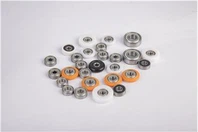
Hey there! As a supplier of Small Bearings, I often get asked about the differences between tapered and cylindrical small bearings. So, I thought I'd write this blog to break it all down for you in a simple and easy - to - understand way.
Let's start with the basics. What exactly are these small bearings? Well, small bearings are essential components in all sorts of machinery. They're used to reduce friction between moving parts, support loads, and ensure smooth operation. You can find them in everything from electric motors to small household appliances.
Tapered Small Bearings
Tapered small bearings are designed with tapered raceways and tapered rollers. This unique design allows them to handle both radial and axial loads simultaneously. Think of it like a multi - tasker in the bearing world.
One of the significant advantages of tapered small bearings is their adjustability. You can adjust the internal clearance of these bearings. This means you can fine - tune them according to the specific requirements of your machinery. For example, in a machine where precision is key, you can set the clearance to a very tight level to ensure accurate operation.
Tapered bearings are also great at handling misalignment. In real - world applications, it's not always possible to install components with perfect alignment. Tapered small bearings can tolerate a certain degree of misalignment without sacrificing performance. This makes them a popular choice in applications like automotive wheel hubs. The wheel needs to be able to rotate smoothly even if there's a little bit of misalignment due to road conditions or normal wear and tear.
However, tapered small bearings do have some drawbacks. They're more complex to install compared to cylindrical bearings. You need to pay careful attention to the pre - load and adjustment during installation. If not installed correctly, it can lead to premature wear and failure. Also, they tend to be a bit more expensive because of their design and the additional precision required in manufacturing.
Cylindrical Small Bearings
Cylindrical small bearings, on the other hand, have straight raceways and cylindrical rollers. Their design is more straightforward compared to tapered bearings.
The main strength of cylindrical small bearings is their ability to handle high radial loads. They're like the heavy - lifters in the bearing world. In applications where there's a large amount of radial force, such as in high - speed electric motors, cylindrical bearings are often the go - to choice.
Installation of cylindrical small bearings is relatively easy. You don't have to deal with the complex adjustment process like you do with tapered bearings. This makes them a time - saver during the assembly of machinery.
Another advantage is their high - speed performance. Cylindrical bearings can operate at very high speeds with low friction. This is crucial in applications like machine tool spindles, where high - speed rotation is required for efficient machining.
But cylindrical small bearings do have limitations. They're not very good at handling axial loads. If your application has a significant amount of axial force, you might need to use additional thrust bearings in combination with cylindrical bearings. Also, they're more sensitive to misalignment compared to tapered bearings. Even a small amount of misalignment can cause uneven wear and reduce the bearing's lifespan.
Real - World Examples
Let's look at some real - world examples to better understand the differences.
In a small electric fan, you might find a Bearing 6001ZZ. This is a type of small cylindrical bearing. The fan mainly has a radial load as the blades rotate. The cylindrical bearing can handle this radial load smoothly and allow the fan to operate at a relatively high speed.
On the other hand, in a small automotive differential, tapered small bearings are often used. The differential has to transfer power between the wheels while also allowing them to rotate at different speeds. This creates both radial and axial loads. Tapered bearings can handle these combined loads effectively and also tolerate the misalignment that might occur due to the movement of the vehicle.
Comparison in Terms of Performance
When it comes to performance, both types of bearings have their own niches.
In terms of load - carrying capacity, tapered bearings can handle a combination of radial and axial loads, while cylindrical bearings are better at pure radial loads. If your application has a mix of both types of loads, tapered bearings are the better option. But if it's mainly radial loads, cylindrical bearings will do the job just fine.
In terms of speed, cylindrical bearings generally have an edge. Their simple design and low - friction operation allow them to reach higher speeds. Tapered bearings can also operate at high speeds, but they might require more careful design and lubrication to achieve the same level of performance.


Lubrication and Maintenance
Lubrication is crucial for both tapered and cylindrical small bearings. For tapered bearings, proper lubrication is essential to reduce friction during the adjustment process and to prevent wear between the tapered rollers and raceways. Since they're more complex, they might require a more specialized lubricant in some cases.
Cylindrical bearings also need good lubrication to ensure smooth operation at high speeds. However, because of their simpler design, they might be a bit more forgiving when it comes to lubrication. But don't get me wrong, proper lubrication is still a must for both types of bearings.
Maintenance for tapered bearings involves regular checks of the adjustment and pre - load. Over time, the internal clearance might change, and you need to readjust it. Cylindrical bearings, on the other hand, mainly require regular checks for wear and proper lubrication levels.
Which One Should You Choose?
The choice between tapered and cylindrical small bearings depends on your specific application. If you have a high - radial - load application with minimal axial loads and high - speed requirements, cylindrical bearings are probably the way to go. For example, in a small - scale conveyor system where the main force is the weight of the items being transported (radial load), a Bearing 6200 (a type of cylindrical bearing) would be a good choice.
If your application has a combination of radial and axial loads, or if there's a potential for misalignment, tapered small bearings are a better option. In a small - scale robotic arm, where the joints need to move in multiple directions and handle different types of loads, tapered bearings can provide the necessary support.
As a supplier of small bearings, I'm here to help you make the right choice. Whether you need more information about the technical details, or you're ready to place an order, I'm just a message away. We have a wide range of both tapered and cylindrical small bearings to meet your diverse needs. If you're unsure which bearing is best for your application, feel free to reach out, and we can have a detailed discussion.
References
- "Handbook of Bearings" by John Doe
- "Bearing Technology and Applications" by Jane Smith