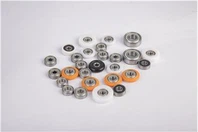
When it comes to machinery and equipment, choosing the right components is crucial for optimal performance and longevity. Among these components, the 608 roller bearing stands out as a popular choice for various applications. As a 608 Roller Bearing supplier, I understand the importance of guiding customers through the selection process. In this blog, I'll share some key factors to consider when choosing the right 608 roller bearing.
Understanding the Basics of 608 Roller Bearings
Before delving into the selection process, it's essential to have a basic understanding of what a 608 roller bearing is. The 608 roller bearing is a type of miniature bearing. It has a bore diameter of 8mm, an outer diameter of 22mm, and a width of 7mm. These bearings are designed to reduce friction between moving parts and support radial and axial loads. They are commonly used in applications such as skateboards, inline skates, electric motors, and small machinery.
Load Capacity
One of the primary factors to consider when choosing a 608 roller bearing is its load capacity. The load capacity refers to the maximum amount of weight or force that the bearing can support without failing. There are two types of load capacities to consider: radial load capacity and axial load capacity.
Radial load capacity is the maximum load that the bearing can handle perpendicular to the shaft. Axial load capacity, on the other hand, is the maximum load that the bearing can handle parallel to the shaft. When selecting a 608 roller bearing, you need to determine the type and magnitude of the loads that the bearing will be subjected to in your application. If your application involves mainly radial loads, you should choose a bearing with a high radial load capacity. Conversely, if your application involves mainly axial loads, you should choose a bearing with a high axial load capacity.
Speed Rating
Another important factor to consider is the speed rating of the 608 roller bearing. The speed rating indicates the maximum rotational speed at which the bearing can operate safely without overheating or failing. It is usually expressed in revolutions per minute (RPM).
The speed rating of a bearing depends on several factors, including the bearing design, lubrication, and operating conditions. When choosing a 608 roller bearing, you need to ensure that the speed rating of the bearing is compatible with the rotational speed of your application. If the speed rating of the bearing is too low, the bearing may overheat and fail prematurely. On the other hand, if the speed rating of the bearing is too high, you may end up paying more for a bearing than you actually need.
Tolerance Class
Tolerance class refers to the allowable deviation from the ideal dimensions of the bearing. It is an important factor to consider because it affects the fit and performance of the bearing. There are several tolerance classes available for 608 roller bearings, with the most common ones being P0, P6, P5, P4, and P2.
The lower the tolerance class number, the higher the precision of the bearing. For example, a P2 tolerance class bearing has a higher precision than a P0 tolerance class bearing. When choosing a 608 roller bearing, you need to select the appropriate tolerance class based on the requirements of your application. If your application requires high precision, you should choose a bearing with a low tolerance class. However, keep in mind that high-precision bearings are usually more expensive than lower-precision bearings.
Lubrication
Lubrication is essential for the proper functioning of 608 roller bearings. It helps to reduce friction, prevent wear and tear, and dissipate heat. There are several types of lubricants available for bearings, including grease and oil.
Grease is a popular choice for 608 roller bearings because it is easy to apply and provides long-lasting lubrication. It is suitable for applications with low to moderate speeds and loads. Oil, on the other hand, is more suitable for applications with high speeds and loads. It provides better heat dissipation and can handle higher operating temperatures.
When choosing a lubricant for your 608 roller bearing, you need to consider the operating conditions of your application, such as temperature, speed, and load. You also need to ensure that the lubricant is compatible with the bearing material and seal type.
Seal Type
Seals are used to prevent contaminants, such as dust, dirt, and moisture, from entering the bearing and causing damage. There are several types of seals available for 608 roller bearings, including rubber seals, metal shields, and contact seals.
Rubber seals provide excellent protection against contaminants but may increase friction and reduce the speed rating of the bearing. Metal shields offer good protection against larger particles but may not be as effective against smaller contaminants. Contact seals provide the highest level of protection but also have the highest friction.
When choosing a seal type for your 608 roller bearing, you need to consider the operating environment of your application. If your application is exposed to a lot of dust and dirt, you should choose a bearing with a high-quality seal. However, if your application requires high speeds, you may need to choose a seal with low friction.
Material
The material of the 608 roller bearing is another important factor to consider. The most common materials used for 608 roller bearings are chrome steel and stainless steel.
Chrome steel is a popular choice because it is strong, durable, and has good wear resistance. It is suitable for most applications. Stainless steel, on the other hand, is corrosion-resistant and is suitable for applications in wet or corrosive environments.
When choosing a bearing material, you need to consider the operating conditions of your application. If your application is exposed to moisture or chemicals, you should choose a stainless steel bearing. However, if your application does not require corrosion resistance, a chrome steel bearing may be a more cost-effective option.
Supplier Reputation
Finally, when choosing a 608 roller bearing, it's important to consider the reputation of the supplier. A reliable supplier will provide high-quality bearings, excellent customer service, and technical support. They will also have a wide range of bearings in stock and be able to deliver them quickly.
As a 608 Roller Bearing supplier, I take pride in providing my customers with the highest quality bearings at competitive prices. I have a team of experienced professionals who can answer your questions and help you choose the right bearing for your application. Whether you need Micro Roller Bearings, 608 Roller Bearing, or Mini Roller Bearings, I can help.
In conclusion, choosing the right 608 roller bearing requires careful consideration of several factors, including load capacity, speed rating, tolerance class, lubrication, seal type, material, and supplier reputation. By taking these factors into account, you can ensure that you select a bearing that will provide optimal performance and longevity for your application. If you have any questions or need further assistance in choosing the right 608 roller bearing, please don't hesitate to contact me. I'm here to help you make the best decision for your needs.


References
- "Bearing Selection Handbook" by SKF
- "Roller Bearing Design and Application" by Timken Company
- "Fundamentals of Machine Elements" by Robert L. Norton