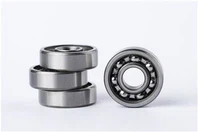
The choice of lubricant for Bearing 6305 is a critical factor that significantly influences its service life. As a reliable supplier of Bearing 6305, I have witnessed firsthand how different lubricant types can either extend or shorten the lifespan of this widely - used bearing. In this blog, I will delve into the various lubricant types suitable for Bearing 6305 and explain how they impact its service life.
Types of Lubricants for Bearing 6305
Grease Lubricants
Grease is one of the most commonly used lubricants for Bearing 6305. It is a semi - solid lubricant composed of a base oil, a thickener, and additives. The base oil provides the lubricating properties, while the thickener holds the oil in place and gives the grease its consistency.
There are different types of base oils used in grease, such as mineral oil, synthetic oil, and vegetable oil. Mineral oil - based greases are cost - effective and offer good general - purpose lubrication. They are suitable for normal operating conditions of Bearing 6305, where the temperature and load are within typical ranges. However, their performance may degrade at high temperatures or in harsh environments.
Synthetic oil - based greases, on the other hand, have superior thermal stability and oxidation resistance. They can withstand higher temperatures without breaking down, which is crucial for applications where Bearing 6305 operates under elevated temperatures. For example, in industrial machinery with high - speed rotating parts, synthetic greases can prevent the bearing from overheating and reduce wear and tear, thus extending its service life.
Vegetable oil - based greases are environmentally friendly options. They have good lubricating properties and are biodegradable. Although they may not have the same high - temperature performance as synthetic greases, they are suitable for applications where environmental concerns are a priority, and the operating conditions are relatively mild.
The thickener in grease also plays an important role. Lithium - based thickeners are widely used due to their excellent mechanical stability and water resistance. They can maintain the structure of the grease under high - speed rotation and prevent water from washing away the lubricant, which is beneficial for Bearing 6305 in applications exposed to moisture.
Oil Lubricants
Oil lubricants are another option for Bearing 6305. They offer better heat dissipation compared to greases, which is essential for high - speed and high - load applications.
Mineral oils are commonly used as base oils for oil lubricants. They are inexpensive and have good lubricating properties. However, they may require more frequent replacement due to their relatively poor oxidation resistance.
Synthetic oils, such as polyalphaolefins (PAOs) and esters, are more advanced oil lubricants. PAOs have excellent low - temperature fluidity and high - temperature stability. They can form a thin and uniform lubricating film on the bearing surfaces, reducing friction and wear. Esters, on the other hand, have good solubility for additives and can provide enhanced anti - wear and anti - corrosion protection.
Oil lubrication systems can be either splash lubrication or forced - feed lubrication. Splash lubrication is a simple and cost - effective method where the bearing is partially submerged in the lubricating oil, and the rotation of the bearing splashes the oil onto the bearing surfaces. Forced - feed lubrication, however, uses a pump to deliver a continuous supply of oil to the bearing, ensuring better lubrication and cooling, especially in high - performance applications.
How Lubricant Type Affects the Service Life of Bearing 6305
Friction and Wear Reduction
The primary function of a lubricant is to reduce friction between the moving parts of Bearing 6305. Different lubricant types have different abilities to form a lubricating film. A high - quality lubricant, whether it is grease or oil, can form a continuous and stable film between the rolling elements and the raceways of the bearing.
Grease lubricants with proper viscosity and consistency can fill the gaps between the bearing components and prevent direct metal - to - metal contact. This reduces friction and wear, which is essential for extending the service life of the bearing. For example, a well - formulated synthetic grease can significantly reduce the coefficient of friction compared to a low - quality mineral oil - based grease, resulting in less wear on the bearing surfaces over time.
Oil lubricants, especially synthetic oils, can form a thinner but more uniform lubricating film. This film can effectively separate the moving parts and reduce friction. In high - speed applications, the ability of oil to quickly dissipate heat generated by friction is crucial. If the friction is not properly controlled, it can lead to excessive heat, which may cause the bearing material to expand and deform, ultimately shortening the service life of Bearing 6305.
Corrosion Protection
Bearing 6305 is often exposed to various environmental factors that can cause corrosion. Moisture, oxygen, and chemicals in the surrounding environment can react with the bearing material, leading to rust and corrosion.
Grease lubricants with anti - corrosion additives can provide a protective barrier on the bearing surfaces. The thickener in the grease can help to trap the additives and keep them in contact with the bearing, preventing moisture and oxygen from reaching the metal. For example, lithium - based greases with anti - rust additives can effectively protect Bearing 6305 in humid environments.
Oil lubricants can also offer corrosion protection. Synthetic oils with anti - corrosion additives can form a chemical bond with the bearing surface, creating a protective layer that resists corrosion. In addition, the continuous flow of oil in a forced - feed lubrication system can wash away any contaminants that may cause corrosion, further enhancing the protection of the bearing.
Temperature Resistance
The operating temperature of Bearing 6305 can have a significant impact on its service life. High temperatures can cause the lubricant to break down, lose its viscosity, and lose its lubricating properties.
Synthetic lubricants, both grease and oil, have better temperature resistance compared to mineral - based lubricants. Synthetic greases can maintain their consistency and lubricating properties at higher temperatures, preventing the bearing from seizing due to lubricant failure. Synthetic oils can also withstand high temperatures without significant degradation, ensuring continuous lubrication and cooling of the bearing.
In applications where Bearing 6305 operates at low temperatures, the low - temperature fluidity of the lubricant is crucial. Synthetic oils, such as PAOs, have excellent low - temperature fluidity, which allows them to flow freely and provide lubrication even in cold environments. Greases with suitable base oils and thickeners can also maintain their flexibility at low temperatures, ensuring proper lubrication of the bearing.

Contamination Resistance
Contamination is another factor that can affect the service life of Bearing 6305. Dust, dirt, and other particles can enter the bearing and cause abrasion and damage to the bearing surfaces.
Grease lubricants can act as a barrier to prevent contaminants from entering the bearing. The thick consistency of grease can trap particles and prevent them from reaching the critical bearing components. However, over time, the grease may become saturated with contaminants, reducing its effectiveness. Regular grease replacement is necessary to maintain its contamination - resistance properties.
Oil lubricants in a forced - feed lubrication system can act as a flushing agent, removing contaminants from the bearing. The continuous flow of oil can carry away particles and prevent them from accumulating on the bearing surfaces. However, the oil filter in the lubrication system needs to be regularly maintained to ensure its effectiveness in removing contaminants.
Conclusion
In conclusion, the lubricant type of Bearing 6305 has a profound impact on its service life. Whether you choose grease or oil lubricants, and the specific type of base oil and additives, should be carefully considered based on the operating conditions of the bearing, such as temperature, load, speed, and environmental factors.
As a supplier of Bearing 6305, I am committed to providing high - quality bearings and professional advice on lubricant selection. If you are looking for a reliable Bearing 6305 supplier and need more information on lubricant types and their impact on bearing service life, or if you are interested in purchasing Bearing 6305, please feel free to contact me for further discussion and negotiation. I am here to help you make the best choice for your applications and ensure the long - term performance of your bearings.
References
- Harris, T. A., & Kotzalas, M. N. (2007). Rolling Bearing Analysis. Wiley.
- Eschmann, P., Hasbargen, K. - H., & Weigand, H. (1991). Ball and Roller Bearings: Fundamentals. Springer.
- Coy, J. J., & Zaretsky, E. V. (1984). Rolling - Element Bearing Fatigue Life Prediction: A State - of - the - Art Review. NASA.