Several common defects in the forging process of bearing rings:

During the forging process of the bearing ring, due to the defects of the bearing steel material, the forging process, the processing equipment and human factors, the ring crack, over-burning, depression, forging folding and wet cracking caused by the defects, these defects can cause the bearing damage. , and will affect the bearing life, resulting in early damage to the bearing.
The following shares several common defects in the forging process of bearing rings, hoping to help you to do early prevention.
1. Cracks in bearing forgings caused by defects in raw materials
(1) The outer diameter of the bearing forging has a penetrating crack. The reason for the crack is that there is a relatively obvious rolling crack on the surface of the bearing steel bar. In forging, after the bearing steel bar containing surface cracks is pressed, the cracks further expand into the shape.

(2) Cracks in the core of the bearing forgings. After the forgings are nested, there are obvious cracks in the core of the inner ring forgings. The length of the crack is 30mm, accounting for about 3/4 of the diameter of the ferrule, the maximum width is 5mm locally, and the depth is about 10mm.
The main reason for this defect is that there is a crack in the core of the bearing steel bar. After the hot pickling of the bearing steel bar cutting sample, there is a deep crack with a length of 10mm and a width of 1mm, and the crack is penetrating. After this kind of material with cracks is put into production, the cracked material is further expanded after forging.
(3) After taking measures, the raw materials of bearing steel shall be strictly inspected according to the inspection specifications of bearing steel entering the factory to ensure that qualified bearing steel is put into production and use.
2. Overburning of forgings
Small holes are scattered on the surface of the bearing ring forging after turning. The metallographic microstructure has been oxidized and overburned. The main reason for this defect is that if the heating temperature of the bearing ring exceeds the upper limit of the process rules during forging, the holding time at this temperature is very long, which will lead to overheating of the material, and in severe cases, it will be overburned, causing the metal grain boundaries to be oxidized and cracked. Spiked cave. The appearance of the forged and burnt ferrule is like an orange peel, with small cracks and a thick oxide scale scattered on it. Because the surface of the ferrule after forging is covered with oxide skin, it is generally not easy to find, and the over-burning characteristics can be fully exposed after grinding.
Measures to be taken:
The bearing steel heating installation is equipped with a three-way sorting mechanism, which can automatically sort underheated and overheated products. After three-way sorting and installation, the workpieces that are under-heated (lack of 1050°C) are selected, and the forging process can be stopped normally after reheating to the allowable initial forging temperature; the workpieces that are overheated and over-burned (temperature exceeds 1150°C) cannot be reheated and put into use. , should be placed in a special covered red box for isolation, and should be cleared and scrapped before shift changes to ensure that the heating temperature is within the required range.
3. Forging and folding
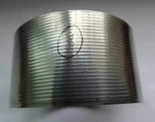
When the ferrule forgings are reamed and rolled, the plane concave is too deep, exceeding the grinding allowance, and there will be long arc-shaped cracks on the plane when they are scrapped. This defect is called forging folding. The reason for this is that the ferrule can be composed of two (or more) metal convections during the forging process; it can also be composed of a rapid and large amount of metal movement that moves the adjacent local surface metal, and the two are assembled; it can also be composed of The deformed metal is formed by bending and reflowing; it can also be formed by deforming a part of the metal part and being pressed into another part of the metal. Folding is related to raw material and blank shape, mold design, forming process layout, smoothness and forging practice.

4. Forging depression
The inner diameter of the NINGBO DAZ bearing ring forging is concave, which is caused by the burr on the surface of the die due to wear during the forging and reaming process of the ring, which causes the inner diameter of the ring to contact the die to generate grooves after reaming. After turning, the defect has some deep depressions that are not completely eliminated.
Measures to be taken: Strictly control the life of the mold, and adjust the life of the mold in a timely manner to avoid defects after mold wear.

5. Forging wet crack
There are obvious linear, oblique and dendritic cracks on the outer diameter, end face and chamfer of DAZ bearing rings. There is obvious decarburization around the crack and the tail of the crack is bald, which is called forging wet crack. The reason is that after the forging and reaming of the ferrule is completed, some ferrules encounter water in the air when they are still at a certain temperature, resulting in wet cracking.
Measures to be taken: Before working every day, clear the cooling water drainage ditch at the reaming equipment to ensure that there is no water in the air. The ferrule will fall into the water to form a wet crack of the ferrule after the hole is reamed.