Abstract
Preload is a key technology in bearing applications, particularly for deep groove ball bearings. Proper preload can significantly improve bearing stiffness, rotational accuracy, and service life, while also suppressing vibration and noise. This article systematically explains the basic concepts, main functions, application methods, estimation principles, and practical considerations for deep groove ball bearing preload.

Ⅰ What is Preload?
Preload refers to the application of a constant initial load, in the opposite direction of the rated load, to the bearing during installation. This load creates a compressed state between the bearing's rolling elements (steel balls) and the inner and outer ring raceways even when no external load is applied, eliminating any initial clearance within the bearing and even creating a certain amount of negative clearance (i.e., a preload state).
Simply put, preload applies an internal pressure to the bearing before it begins operation, pre-tensioning it.
ⅡThe Main Functions of Preload
Applying appropriate preload to deep groove ball bearings provides the following benefits:
1. Improved axial and radial stiffness: Preload causes elastic deformation at the contact point between the balls and the raceways. When an external load is applied, the bearing must overcome this initial deformation before further movement can occur, resulting in a higher resistance to deformation (i.e., stiffness). This is crucial for applications requiring high stiffness, such as precision machine tool spindles and gearboxes.
2. Improved rotational accuracy: Preload eliminates internal bearing clearance, effectively suppressing radial and axial play in the shafting and reducing spindle runout, thereby ensuring higher rotational accuracy.
3. Suppressed vibration and noise: Because clearance is eliminated, the balls do not collide during operation, reducing vibration and noise and ensuring smoother operation.
4. Extended fatigue life (under certain conditions): Under light loads or loads with varying directions, appropriate preload can more evenly distribute the load across a larger number of balls, avoiding localized excessive stress and potentially extending the bearing's fatigue life. However, be aware that excessive preload can significantly shorten bearing life.
Ⅲ. Preload Application Methods
Based on whether the preload can be adjusted after application, it can be categorized as fixed-position preload or fixed-pressure preload. Deep groove ball bearings typically use fixed-position preload.
1. Fixed-position Preload
The relative axial position of the bearing inner and outer rings is mechanically fixed to achieve a fixed preload. The preload amount is determined during installation and cannot be changed. Common methods include:

① Using a lock nut: The nut presses the bearing inner ring against the shaft shoulder or spacer.
②Using pre-ground spacers: A precision-ground spacer of precisely calculated length is placed between the inner or outer rings of two bearings. When tightened with an end cap or nut, the length of the spacer determines the preload amount. This is the most common and reliable method.
③Adjusting the end cap: The outer ring of the bearing is tightened by adjusting the position of the bearing housing end cap.
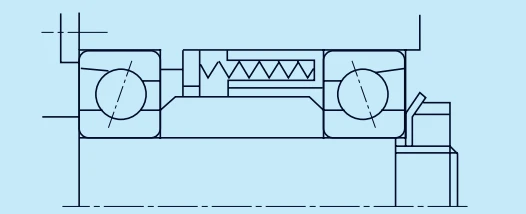
2. Constant Pressure Preload
This method uses elastic elements such as springs (disc springs, coil springs) to apply a constant preload to the bearing. Its advantage is that the preload remains stable despite bearing temperature rise or wear. This method is relatively uncommon with deep groove ball bearings and is more common with angular contact ball bearings.
Ⅳ Preload Estimation and Influencing Factors
Preload is not a precisely calculated value; rather, it is an engineering parameter that requires a comprehensive trade-off and estimation based on operating conditions and objectives (stiffness, accuracy, and life).
As a rule of thumb, the preload is typically 20% to 30% of the expected maximum working load. For high-speed applications, the preload should be lower to reduce heat generation; for applications requiring high stiffness, the preload can be appropriately increased.
Relationship between Preload Amount and Preload Force: After preload is applied, there is a nonlinear relationship between the axial displacement within the bearing (i.e., preload δ) and the resulting preload force (F₀), which follows Hertzian contact theory. Generally, preload is proportional to the 3/2 power of the preload (F₀ ∝ δ^(3/2)). This means that a small increase in preload can result in a significant increase in preload.
Key Influencing Factors:
Fit Tolerances: The interference fit between the bearing, shaft, and housing will partially reduce the bearing's original clearance, effectively applying preload indirectly.
Temperature Effects: During system operation, there may be a temperature difference between the inner and outer rings of the bearing, resulting in different thermal expansion rates, which can change the preset preload. Typically, the inner ring temperature is higher than the outer ring, resulting in increased preload, which must be considered during design.
Machining Errors: Perpendicularity and parallelism errors in the shaft shoulder and spacer end faces can lead to uneven preload and even cause additional bending moments.
Ⅴ Dangers of Improper Preload
Insufficient preload: Failure to effectively eliminate clearance leads to low stiffness, poor accuracy, and high vibration and noise.
Excessive preload: This is a more common and dangerous situation, resulting in:
Severe Temperature Rise: Increased friction and significant heat generation. Lubrication failure: High temperatures cause lubricant/grease performance degradation or carbonization.
Fatigue life decreases dramatically: Excessive contact stress leads to premature spalling.
Increased energy consumption: Increased torque.
Ⅵ. Conclusions and Recommendations
Preload is a double-edged sword. Applying preload to deep groove ball bearings is an effective means of improving equipment performance, but its application must be scientific and cautious.
Clear Objectives: First, clarify whether the preload is intended to improve stiffness, precision, or suppress vibration.
Moderation: While meeting performance requirements, use the smallest possible preload. "Better to underload than overload" is a key design principle.
Comprehensive Consideration: All influencing factors, including fit, temperature rise, and machining accuracy, must be comprehensively considered during design.
Preferring Spacers: For critical bearings used in pairs, the use of pre-ground spacers for positioning and preloading is strongly recommended. This is the most reliable method for controlling preload.
Practical Verification: The optimal preload value often requires repeated verification and adjustment through experiments (such as testing temperature rise, vibration, and stiffness). For most general applications, standard deep groove ball bearings can operate with minimal clearance (C0, CN). Preloading technology is primarily used in precision machinery and industrial equipment with special performance requirements.