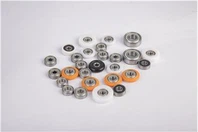
Hey there! As a supplier of 608 Roller Bearing, I often get asked about the noise reduction effect of lubricated 608 roller bearings. So, I thought I'd dive into this topic and share some insights with you.
Understanding the 608 Roller Bearing
First off, let's talk a bit about the 608 roller bearing. It's a type of Micro Roller Bearings and Mini Roller Bearings that's widely used in various applications. These bearings are known for their small size and high precision, making them perfect for things like skateboards, small motors, and even some industrial equipment.
The 608 roller bearing consists of an inner ring, an outer ring, a set of rollers, and a cage that holds the rollers in place. When the bearing is in operation, the rollers roll between the inner and outer rings, allowing for smooth rotation. However, without proper lubrication, this rolling action can generate a fair amount of noise.
The Role of Lubrication in Noise Reduction
Lubrication plays a crucial role in reducing the noise generated by a 608 roller bearing. When a bearing is lubricated, a thin film of lubricant forms between the rollers and the raceways (the surfaces of the inner and outer rings where the rollers roll). This film acts as a buffer, reducing the direct contact between the metal surfaces.
Without lubrication, the metal-to-metal contact between the rollers and the raceways can cause friction and wear. This friction not only generates heat but also produces noise. The noise can range from a low humming sound to a high-pitched screeching, depending on the severity of the friction.
On the other hand, when the bearing is properly lubricated, the lubricant film reduces the friction and wear. This results in a smoother operation and significantly less noise. The lubricant also helps to dissipate heat, which can further improve the performance and lifespan of the bearing.
How Lubrication Reduces Noise
There are several ways in which lubrication reduces the noise of a 608 roller bearing:
1. Reducing Friction
As mentioned earlier, friction is one of the main causes of noise in a bearing. When the lubricant forms a film between the rollers and the raceways, it reduces the coefficient of friction. This means that the rollers can roll more smoothly, with less resistance. As a result, the noise generated by the friction is reduced.
2. Dampening Vibrations
Vibrations are another source of noise in a bearing. When the rollers roll over the raceways, they can cause small vibrations in the bearing. These vibrations can be transmitted through the bearing and into the surrounding equipment, creating noise.
Lubrication helps to dampen these vibrations. The lubricant film acts as a shock absorber, absorbing the energy of the vibrations and preventing them from being transmitted. This reduces the overall noise level of the bearing.
3. Preventing Wear
Wear can also contribute to noise in a bearing. As the bearing wears, the surfaces of the rollers and the raceways become rough. This roughness can cause the rollers to bounce and chatter, generating noise.
Lubrication helps to prevent wear by reducing the friction between the metal surfaces. The lubricant film protects the surfaces from direct contact, reducing the amount of wear. This keeps the surfaces smooth and reduces the noise generated by the wear.
Factors Affecting the Noise Reduction Effect of Lubrication
While lubrication can significantly reduce the noise of a 608 roller bearing, there are several factors that can affect the effectiveness of the lubrication in noise reduction:
1. Type of Lubricant
There are different types of lubricants available for bearings, including oils and greases. Each type of lubricant has its own properties and characteristics, which can affect its noise reduction performance.
Oils are generally better at reducing noise than greases. They have a lower viscosity, which means they can flow more easily and form a thinner lubricant film. This allows for smoother operation and less noise. However, oils also have a lower load-carrying capacity and may require more frequent re-lubrication.
Greases, on the other hand, are more viscous and can provide better protection against contaminants. They are also easier to apply and require less frequent re-lubrication. However, greases may not be as effective at reducing noise as oils, especially at high speeds.
2. Lubricant Quantity
The amount of lubricant used in a bearing can also affect its noise reduction performance. If there is too little lubricant, the bearing may not be properly lubricated, and the noise reduction effect will be limited. On the other hand, if there is too much lubricant, it can cause the bearing to overheat and generate more noise.


The optimal amount of lubricant depends on the size and type of the bearing, as well as the operating conditions. It's important to follow the manufacturer's recommendations for lubricant quantity to ensure the best noise reduction performance.
3. Operating Conditions
The operating conditions of the bearing, such as speed, load, and temperature, can also affect the noise reduction effect of lubrication. At high speeds, the lubricant film may be more easily disrupted, reducing its effectiveness in reducing noise. Similarly, high loads can cause the lubricant film to break down, leading to increased friction and noise.
Temperature also plays a role. At high temperatures, the lubricant may become thinner and lose its viscosity, reducing its ability to form a protective film. On the other hand, at low temperatures, the lubricant may become too thick, increasing the friction and noise.
Measuring the Noise Reduction Effect
To measure the noise reduction effect of a lubricated 608 roller bearing, several methods can be used. One common method is to use a sound level meter. The sound level meter measures the sound pressure level (SPL) of the bearing in decibels (dB). By comparing the SPL of the bearing before and after lubrication, the noise reduction effect can be determined.
Another method is to use vibration analysis. Vibration sensors can be used to measure the vibrations generated by the bearing. By analyzing the vibration signals, the noise level and the noise reduction effect can be estimated.
Conclusion
In conclusion, lubrication is essential for reducing the noise generated by a 608 roller bearing. By forming a thin film between the rollers and the raceways, lubrication reduces friction, dampens vibrations, and prevents wear, resulting in a smoother operation and less noise.
However, the effectiveness of the lubrication in noise reduction depends on several factors, such as the type of lubricant, the lubricant quantity, and the operating conditions. It's important to choose the right lubricant and apply it in the correct amount to ensure the best noise reduction performance.
If you're in the market for high-quality 608 roller bearings or need more information about their noise reduction capabilities, feel free to reach out. We're here to help you find the perfect solution for your needs. Whether you're a skateboard enthusiast, a small business owner, or an industrial manufacturer, we've got the bearings you need to keep your equipment running smoothly and quietly.
References
- Harris, T. A., & Kotzalas, M. N. (2007). Rolling Bearing Analysis. Wiley-Interscience.
- Zaretsky, E. V. (2007). Rolling Bearing Fatigue Life: Selection and Application. CRC Press.
- Wang, Q., & Zhu, S. (2018). Tribology of Rolling Bearings. Elsevier.