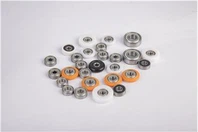
Hey there! As a supplier of 608 Roller Bearings, I often get asked about the maximum misalignment these bearings can tolerate. It's a crucial question, especially for those looking to use these bearings in various applications. So, let's dive right in and explore this topic in detail.
First off, let's understand what 608 Roller Bearings are. The 608 Roller Bearing is a type of miniature roller bearing. Miniature bearings, in general, are designed for applications where space is limited, and precision is key. They come in different types, including Micro Roller Bearings and Mini Roller Bearings. These bearings are used in a wide range of industries, such as robotics, medical equipment, and consumer electronics.
Now, when it comes to misalignment, it's important to know that no bearing can handle an infinite amount of it. Misalignment can occur in two main ways: angular misalignment and parallel misalignment. Angular misalignment is when the axes of the inner and outer rings of the bearing are not parallel, while parallel misalignment is when the axes are parallel but offset from each other.
The maximum misalignment a 608 Roller Bearing can tolerate depends on several factors. One of the most important factors is the design of the bearing itself. The internal geometry of the bearing, including the shape and size of the rollers and raceways, plays a significant role in determining its misalignment tolerance. For example, bearings with spherical rollers can generally tolerate more angular misalignment than those with cylindrical rollers.
Another factor is the load on the bearing. Higher loads can reduce the bearing's ability to tolerate misalignment. When a bearing is under a heavy load, the forces acting on the rollers and raceways are greater, and any misalignment can cause uneven stress distribution, leading to premature wear and failure.


The operating speed of the bearing also affects its misalignment tolerance. At higher speeds, the dynamic forces acting on the bearing increase, and misalignment can cause vibrations and noise. This can not only affect the performance of the bearing but also the overall system in which it is used.
In general, the maximum angular misalignment for a 608 Roller Bearing is typically in the range of 0.5 to 2 degrees. However, this can vary depending on the specific design and application of the bearing. For parallel misalignment, the tolerance is usually much smaller, often in the range of a few thousandths of an inch.
It's important to note that these are just general guidelines, and the actual misalignment tolerance of a 608 Roller Bearing can be determined through testing and analysis. At our company, we have a team of experts who can help you determine the appropriate misalignment tolerance for your specific application. We use advanced testing equipment and techniques to simulate real-world conditions and ensure that our bearings meet the highest standards of performance and reliability.
So, why is it so important to keep the misalignment within the bearing's tolerance? Well, if the misalignment exceeds the bearing's capacity, it can lead to a number of problems. As mentioned earlier, it can cause uneven stress distribution, which can result in premature wear of the rollers and raceways. This can lead to increased friction, heat generation, and noise, and ultimately, bearing failure. In addition, misalignment can also affect the performance of the entire system in which the bearing is used, leading to reduced efficiency and productivity.
To prevent misalignment issues, it's important to follow proper installation procedures. This includes ensuring that the bearing is installed correctly on the shaft and in the housing, and that the shaft and housing are properly aligned. It's also a good idea to use alignment tools and techniques during the installation process to ensure accuracy.
Regular maintenance and inspection are also crucial. By monitoring the bearing's performance and checking for signs of misalignment, such as abnormal noise or vibration, you can catch potential problems early and take corrective action before they cause significant damage.
In conclusion, the maximum misalignment a 608 Roller Bearing can tolerate depends on several factors, including the bearing's design, load, and operating speed. While general guidelines exist, it's important to consult with experts to determine the appropriate misalignment tolerance for your specific application. At our company, we're committed to providing high-quality 608 Roller Bearings and expert advice to help you get the most out of your bearings. If you're in the market for 608 Roller Bearings or have any questions about misalignment or bearing performance, don't hesitate to reach out to us. We'd be happy to discuss your needs and help you find the right solution for your application.
References:
- "Rolling Bearing Analysis" by T. A. Harris and M. N. Kotzalas
- "Bearing Engineering Handbook" by SKF