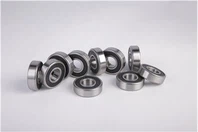
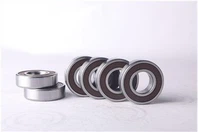
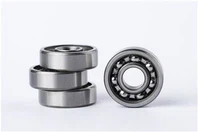
Hey there! As a supplier of Miniature Bearings, I often get asked about the material hardness of these little but crucial components. So, today I'm gonna break it down for you and share some insights on what the material hardness of miniature bearings is all about.
First off, let's understand why material hardness matters in miniature bearings. Miniature bearings are used in a wide range of applications, from small motors in home appliances to precision instruments. They need to withstand various loads, speeds, and operating conditions. The hardness of the bearing material directly affects its performance, durability, and resistance to wear and deformation.
The most common materials used for miniature bearings are steel and ceramic. Let's start with steel. Steel bearings are widely used because they offer a good balance of strength, toughness, and cost - effectiveness. The hardness of steel bearings is typically measured on the Rockwell C scale (HRC). For standard steel miniature bearings, the hardness usually ranges from 58 to 64 HRC.
This level of hardness allows the bearings to handle moderate to high loads. The steel's hardness is achieved through a heat - treating process. During heat treatment, the steel is heated to a specific temperature and then rapidly cooled, which changes its internal structure and increases its hardness. However, if the hardness is too high, the steel can become brittle and more prone to cracking under shock loads. On the other hand, if the hardness is too low, the bearing will wear out quickly.
Now, let's talk about ceramic bearings. Ceramic materials, such as silicon nitride (Si₃N₄), are becoming increasingly popular in miniature bearing applications. Ceramic bearings have a much higher hardness compared to steel bearings. Their hardness can reach up to 75 - 80 on the Rockwell A scale (HRA), which is equivalent to about 900 - 1000 Vickers hardness (HV).
The high hardness of ceramic bearings gives them several advantages. They are extremely wear - resistant, which means they can last much longer than steel bearings, especially in high - speed or high - precision applications. Ceramic bearings also have a lower coefficient of friction, which reduces heat generation and energy consumption. Moreover, they are corrosion - resistant, making them suitable for use in harsh environments.
But ceramic bearings also have some drawbacks. They are more expensive to manufacture than steel bearings, which can be a limiting factor for some applications. And because of their high hardness, they can be more difficult to machine, which may lead to higher production costs.
Another factor that affects the material hardness of miniature bearings is the type of application they are used in. For example, in a 6901ZZ --Thin Section Bearings/Floor Sweeper Motor, the bearing needs to be able to handle the vibrations and relatively low - to - moderate loads generated by the floor sweeper motor. A steel bearing with a hardness in the typical range of 58 - 64 HRC would be a good choice here.
In a Ball Bearing Wheels Home Appliance, the bearing may need to operate smoothly with low friction over a long period. Depending on the specific requirements of the home appliance, either a steel or a ceramic bearing could be used. If the appliance is in a moist or corrosive environment, a ceramic bearing might be the better option due to its corrosion resistance.
For a 20mm Roller Bearing, the hardness of the material is also crucial. Roller bearings are designed to handle radial and axial loads, so the material needs to be hard enough to resist deformation under these loads. Again, the choice between steel and ceramic depends on factors like load capacity, speed, and the operating environment.
When it comes to measuring the hardness of miniature bearings, there are several methods. One common method is the Rockwell hardness test, which involves indenting the material with a diamond cone or a steel ball and measuring the depth of the indentation. Another method is the Vickers hardness test, which uses a square - based diamond pyramid indenter. These tests provide accurate and reliable results, allowing manufacturers to ensure that the bearings meet the required hardness standards.
In addition to the base material hardness, the surface hardness of the bearing also plays an important role. Surface treatments, such as nitriding or carburizing, can be applied to increase the surface hardness of the bearing. This can improve the bearing's wear resistance and reduce friction.
As a Miniature Bearings supplier, I know that choosing the right bearing with the appropriate material hardness is crucial for the success of your application. Whether you need a bearing for a small motor, a precision instrument, or a home appliance, we have a wide range of options to meet your needs.
If you're in the market for miniature bearings and want to learn more about how the material hardness can impact your application, or if you have specific requirements for your project, don't hesitate to get in touch. We're here to help you make the best choice and ensure that your equipment runs smoothly and efficiently.


References
- "Bearing Engineering Handbook"
- "Materials Science and Engineering: An Introduction"
- Industry reports on miniature bearing applications