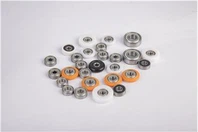
Hey there! As a supplier of Mini Roller Bearings, I'm super excited to take you through the manufacturing process of these tiny yet incredibly important components. Mini Roller Bearings are used in a wide range of applications, from small motors to precision instruments, and understanding how they're made can give you a better appreciation of their quality and performance.
Material Selection
The first step in making Mini Roller Bearings is choosing the right materials. For the bearing rings and rollers, high - quality steel is usually the top choice. We typically go for chromium steel because it offers excellent hardness, wear resistance, and fatigue strength. This type of steel can withstand the high stresses and loads that Mini Roller Bearings often encounter in their applications.
The quality of the raw material is crucial. We source our steel from trusted suppliers who adhere to strict quality control standards. Before starting the manufacturing process, the steel undergoes a series of tests to ensure it meets our specifications. This includes checking its chemical composition, hardness, and microstructure.
Cutting and Forming
Once we have the right steel, it's time to start shaping it into the components of the Mini Roller Bearings. The first step in this process is cutting the steel into the appropriate sizes. We use advanced cutting machines, like saws and lasers, to make precise cuts. The accuracy of these cuts is vital because it determines the dimensions of the final bearing components.
After cutting, the steel pieces are formed into the shape of the bearing rings and rollers. For the bearing rings, we use a process called cold forming. This involves pressing the steel into the desired shape using a die. Cold forming is a cost - effective and efficient way to create high - precision parts. It also helps to improve the mechanical properties of the steel by aligning its grain structure.
The rollers are formed through a similar process. However, they often require additional shaping steps to achieve the perfect cylindrical or tapered shape. This may involve grinding and polishing to ensure a smooth surface finish, which is essential for reducing friction and wear in the bearing.
Heat Treatment
Heat treatment is a critical step in the manufacturing of Mini Roller Bearings. It's used to enhance the hardness, strength, and toughness of the bearing components. The most common heat treatment process for Mini Roller Bearings is quenching and tempering.
During quenching, the bearing components are heated to a high temperature and then rapidly cooled. This causes the steel to transform into a hard martensitic structure. However, martensite is very brittle, so the components need to be tempered to reduce their brittleness and improve their toughness. Tempering involves reheating the quenched components to a lower temperature and holding them there for a specific period of time.
The heat treatment process needs to be carefully controlled to ensure that the bearing components have the right balance of hardness and toughness. Any deviation from the optimal heat treatment parameters can lead to premature failure of the bearings.
Machining and Grinding
After heat treatment, the bearing components need to be machined and ground to achieve the final dimensions and surface finish. Machining processes, such as turning and milling, are used to remove any excess material and create the necessary features on the bearing rings, like the raceways.
Grinding is the most important step in achieving the high precision required for Mini Roller Bearings. We use precision grinding machines to grind the bearing components to within a few micrometers of the desired dimensions. This high level of precision is necessary to ensure proper fit and function of the bearing.
The surface finish of the bearing components is also crucial. A smooth surface finish reduces friction and wear, which extends the life of the bearing. We use various grinding and polishing techniques to achieve a mirror - like surface finish on the bearing rings and rollers.


Assembly
Once all the individual components of the Mini Roller Bearings are ready, it's time to assemble them. The assembly process is carried out in a clean and controlled environment to prevent contamination. First, the rollers are placed in the raceways of the inner and outer bearing rings. Then, a cage is added to keep the rollers evenly spaced and prevent them from rubbing against each other.
The cage is usually made of materials like steel, brass, or plastic. The choice of cage material depends on the application of the bearing. For example, plastic cages are lightweight and offer good corrosion resistance, making them suitable for applications where weight and corrosion are concerns.
After the cage is installed, the bearing is sealed to prevent contaminants from entering and lubricant from leaking out. Seals can be made of rubber or other elastomeric materials. The sealing process needs to be carefully done to ensure a tight fit and effective protection.
Quality Control
Quality control is an ongoing process throughout the manufacturing of Mini Roller Bearings. At every stage, from material selection to assembly, we conduct a series of inspections and tests to ensure that the bearings meet our high - quality standards.
We use various measuring instruments, like micrometers, calipers, and coordinate measuring machines (CMMs), to check the dimensions of the bearing components. These instruments can measure to a very high degree of accuracy, ensuring that the components are within the specified tolerances.
We also perform functional tests on the assembled bearings. This includes testing the rotation torque, radial and axial clearance, and noise levels. Any bearings that do not meet the quality criteria are rejected and either reworked or discarded.
Lubrication
Lubrication is essential for the proper functioning of Mini Roller Bearings. It reduces friction, wear, and heat generation, which extends the life of the bearing. There are different types of lubricants available, such as grease and oil.
The choice of lubricant depends on the application of the bearing. Grease is a popular choice for Mini Roller Bearings because it's easy to apply and provides long - term lubrication. It also helps to seal the bearing and prevent contaminants from entering.
Before shipping the bearings, we apply the appropriate lubricant to ensure that they are ready for use. The amount and type of lubricant are carefully controlled to ensure optimal performance.
Conclusion
So, that's the manufacturing process of Mini Roller Bearings in a nutshell. From material selection to quality control, every step is crucial in producing high - quality bearings that can meet the demanding requirements of various applications.
If you're in the market for Mini Roller Bearings, Mini Roller Bearings are a great option. We also offer Micro Roller Bearings and 608 Roller Bearing for more specific needs.
If you're interested in purchasing our Mini Roller Bearings or have any questions about our products, feel free to reach out. We're always happy to discuss your requirements and provide you with the best solutions.
References
- "Bearing Design and Application Handbook"
- "Manufacturing Engineering and Technology" by S. Kalpakjian and S. R. Schmid