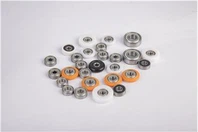
The friction coefficient of pulley bearings is a crucial parameter that significantly influences their performance and application in various industries. As a leading supplier of Pulley Bearings, we understand the importance of this technical aspect and are committed to providing high - quality products with optimized friction coefficients.
Understanding the Friction Coefficient in Pulley Bearings
The friction coefficient is a dimensionless quantity that represents the ratio of the frictional force between two surfaces in contact to the normal force pressing the two surfaces together. In the context of pulley bearings, it determines how smoothly the bearing rotates and how much energy is lost due to friction during operation.


There are two main types of friction coefficients relevant to pulley bearings: static and kinetic. The static friction coefficient comes into play when the bearing is at rest and an external force is applied to initiate motion. A lower static friction coefficient means less force is required to start the rotation of the pulley bearing. On the other hand, the kinetic friction coefficient is applicable when the bearing is in motion. It affects the power consumption and the wear rate of the bearing components.
Factors Affecting the Friction Coefficient of Pulley Bearings
Material of the Bearing Surfaces
The materials used in the construction of pulley bearings have a profound impact on the friction coefficient. For example, bearings made of high - quality steel alloys often have relatively low friction coefficients. Steel is known for its hardness and smooth surface finish, which reduces the contact area and frictional resistance between the moving parts. Some advanced bearings may use ceramic materials. Ceramics offer excellent wear resistance and can have even lower friction coefficients compared to steel in certain applications.
Lubrication
Lubrication is another key factor. A well - lubricated pulley bearing will have a significantly lower friction coefficient. Lubricants form a thin film between the bearing surfaces, separating them and reducing direct contact. This not only reduces friction but also helps in dissipating heat generated during operation. There are different types of lubricants available, such as grease and oil. Grease is often preferred for pulley bearings in applications where long - term lubrication is required without frequent re - application. Oil, on the other hand, is suitable for high - speed applications as it provides better heat dissipation.
Surface Finish
The surface finish of the bearing components plays a vital role. A smoother surface finish results in a lower friction coefficient. During the manufacturing process, precise machining and polishing techniques are employed to achieve the desired surface roughness. Even small irregularities on the surface can increase the contact area and thus the frictional force.
Load and Speed
The load applied to the pulley bearing and the rotational speed also affect the friction coefficient. At higher loads, the contact pressure between the bearing surfaces increases, which can lead to an increase in the friction coefficient. Similarly, high rotational speeds can cause changes in the lubrication film thickness and increase the frictional heat, which may in turn affect the friction characteristics of the bearing.
Importance of the Friction Coefficient in Different Applications
Paper Roller Bearing
In the paper industry, Paper Roller Bearing are widely used. A low friction coefficient is essential in this application as it ensures smooth and continuous operation of the paper - processing machinery. With a lower friction coefficient, the bearings can rotate freely, reducing the power consumption of the equipment and minimizing the wear and tear of the rollers. This results in longer service life of the bearings and improved overall efficiency of the paper - making process.
Industrial Roller Bearings
Industrial Roller Bearings are used in a wide range of industrial applications, from manufacturing plants to heavy machinery. In these settings, the friction coefficient directly impacts the energy efficiency of the equipment. A lower friction coefficient means less energy is wasted as heat, leading to cost savings in the long run. Moreover, it reduces the stress on the bearing components, which helps in preventing premature failures and reducing maintenance costs.
Sliding Gate Roller Bearings
For Sliding Gate Roller Bearings, a low friction coefficient is crucial for smooth and quiet operation. When the gate moves, the bearings need to roll with minimal resistance. This not only makes the opening and closing of the gate easier but also extends the lifespan of the bearing and the gate itself. A high - friction bearing can cause the gate to jam or operate noisily, which is undesirable in both residential and commercial settings.
Measuring the Friction Coefficient of Pulley Bearings
Measuring the friction coefficient of pulley bearings is a complex process that requires specialized equipment. One common method is to use a friction tester. This device applies a known normal force to the bearing and measures the frictional force as the bearing rotates. By dividing the frictional force by the normal force, the friction coefficient can be calculated.
In addition to direct measurement, computer - aided simulation techniques are also used. These simulations can model the behavior of the bearing under different operating conditions and predict the friction coefficient. This approach is useful for designing new bearings and optimizing their performance before actual production.
Controlling and Optimizing the Friction Coefficient
As a Pulley Bearings supplier, we take several steps to control and optimize the friction coefficient of our products.
Material Selection
We carefully select the materials for our bearings based on the specific application requirements. For high - speed applications, we may choose materials with lower friction coefficients and better heat - resistance properties. For heavy - load applications, we focus on materials that can withstand high contact pressures without significant increase in friction.
Advanced Manufacturing Processes
Our manufacturing processes are designed to achieve the best possible surface finish. We use precision machining techniques and advanced polishing methods to ensure that the bearing surfaces are as smooth as possible. This helps in reducing the friction coefficient and improving the overall performance of the bearings.
Lubrication Solutions
We offer a range of lubrication solutions tailored to different applications. Our technical team can provide advice on the most suitable lubricant for a particular bearing and application. We also ensure that the lubrication is applied correctly during the assembly process to maximize its effectiveness.
Conclusion
The friction coefficient of pulley bearings is a critical factor that affects their performance, energy efficiency, and service life. Understanding the factors that influence the friction coefficient and taking appropriate measures to control and optimize it are essential for ensuring the success of various industrial applications.
As a reliable Pulley Bearings supplier, we are dedicated to providing high - quality bearings with optimized friction coefficients. Our products are designed to meet the diverse needs of different industries, whether it is the paper industry, general industrial applications, or sliding gate systems.
If you are interested in our Pulley Bearings or have any questions regarding the friction coefficient and its impact on your specific application, we encourage you to contact us for procurement and further technical discussions. We look forward to serving you and helping you find the best bearing solutions for your needs.
References
- "Bearing Technology Handbook" by Klaus - Dieter Möhring
- "Friction and Wear of Materials" by William O. Winer
- Industry research reports on pulley bearing applications in different sectors.