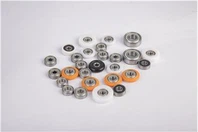
Hey there! As a supplier of paper roller bearings, I often get asked about the differences between paper roller bearings and other types of bearings. So, I thought I'd take a few minutes to break it down for you.
First off, let's talk about what bearings are in general. Bearings are mechanical components that support and guide moving parts, reducing friction and allowing for smooth rotation or linear movement. They're used in a wide range of applications, from small household appliances to large industrial machinery.
Now, let's dive into the different types of bearings and how paper roller bearings stack up.
Ball Bearings
Ball bearings are one of the most common types of bearings. They use balls to separate the moving parts and reduce friction. Ball bearings are great for high-speed applications because the balls can roll smoothly, allowing for efficient rotation. They're also relatively inexpensive and easy to install.
However, ball bearings have some limitations. They're not very good at handling heavy loads or shock loads. When a ball bearing is subjected to a heavy load, the balls can deform or even break, leading to premature failure. Additionally, ball bearings require a certain amount of lubrication to function properly, and if the lubrication runs out or becomes contaminated, the bearing can wear out quickly.
In contrast, paper roller bearings are better suited for heavy-load applications. The rollers in paper roller bearings have a larger contact area with the raceways compared to the balls in ball bearings. This means they can distribute the load more evenly, reducing the stress on the bearing and allowing it to handle heavier loads without deforming or breaking.
Cylindrical Roller Bearings
Cylindrical roller bearings are another type of bearing that's commonly used in industrial applications. They use cylindrical rollers instead of balls to separate the moving parts. Cylindrical roller bearings are known for their high radial load capacity and their ability to handle high speeds.
Like ball bearings, cylindrical roller bearings have some drawbacks. They're not very good at handling axial loads (loads that act parallel to the shaft). When a cylindrical roller bearing is subjected to an axial load, the rollers can shift or tilt, causing uneven wear and reducing the bearing's lifespan.
Paper roller bearings, on the other hand, can handle both radial and axial loads to some extent. The design of paper roller bearings allows them to distribute the load more evenly across the rollers, making them more versatile than cylindrical roller bearings in certain applications.
Tapered Roller Bearings
Tapered roller bearings are designed to handle both radial and axial loads simultaneously. They use tapered rollers that are arranged in a way that allows them to support loads in both directions. Tapered roller bearings are commonly used in automotive applications, such as wheel hubs and transmissions.
While tapered roller bearings are very effective at handling combined loads, they can be more complex and expensive to manufacture compared to other types of bearings. They also require precise installation and adjustment to ensure proper functioning.
Paper roller bearings offer a more cost-effective alternative for applications that require both radial and axial load support. They're easier to install and maintain, and they can provide reliable performance in a wide range of operating conditions.
Spherical Roller Bearings
Spherical roller bearings are designed to accommodate misalignment between the shaft and the housing. They use spherical rollers that can self-align, allowing the bearing to compensate for any angular misalignment. Spherical roller bearings are commonly used in applications where the shaft is subject to bending or where the housing is not perfectly aligned.
However, spherical roller bearings are relatively expensive and can be difficult to install. They also have a relatively low speed limit compared to other types of bearings.


Paper roller bearings can provide a similar level of misalignment compensation at a lower cost. The paper material used in paper roller bearings has some flexibility, which allows the bearing to adapt to minor misalignments without sacrificing performance.
Advantages of Paper Roller Bearings
In addition to their ability to handle heavy loads and misalignment, paper roller bearings have several other advantages.
- Self-lubricating: Paper roller bearings are self-lubricating, which means they don't require external lubrication. This reduces the maintenance requirements and the risk of lubrication-related failures.
- Corrosion-resistant: The paper material used in paper roller bearings is resistant to corrosion, making them suitable for use in harsh environments.
- Quiet operation: Paper roller bearings operate quietly compared to other types of bearings. This makes them ideal for applications where noise is a concern, such as in household appliances or office equipment.
- Cost-effective: Paper roller bearings are generally less expensive than other types of bearings, especially when considering the long-term cost of maintenance and replacement.
Applications of Paper Roller Bearings
Paper roller bearings are used in a wide range of applications, including:
- Paper processing machinery: As the name suggests, paper roller bearings are commonly used in paper processing machinery, such as paper mills, printing presses, and paper converting equipment. They can handle the heavy loads and high speeds associated with these applications.
- Food processing equipment: Paper roller bearings are suitable for use in food processing equipment because they're self-lubricating and corrosion-resistant. They can be used in applications such as conveyors, mixers, and packaging machines.
- Textile machinery: Paper roller bearings are also used in textile machinery, such as spinning machines, weaving machines, and dyeing machines. They can provide smooth and reliable operation in these high-speed applications.
- Automotive industry: Paper roller bearings are used in some automotive applications, such as power windows, sunroofs, and seat adjusters. They can provide quiet and reliable operation in these applications.
Where to Find Paper Roller Bearings and Related Products
If you're interested in paper roller bearings or other types of bearings, you can check out our Sliding Gate Roller Bearings, Industrial Roller Bearings, and 6200zz Garage Door Rollers. These products offer a wide range of options to meet your specific needs.
Conclusion
In conclusion, paper roller bearings offer several advantages over other types of bearings, especially in applications that require heavy load capacity, misalignment compensation, and self-lubrication. They're a cost-effective and reliable solution for a wide range of industries.
If you're looking for a high-quality paper roller bearing supplier, look no further. We have a wide selection of paper roller bearings to meet your specific requirements. Whether you're in the paper processing, food processing, textile, or automotive industry, we can provide you with the right bearing for your application.
If you have any questions or would like to discuss your bearing needs, feel free to reach out. We're here to help you find the best solution for your business.
References
- "Rolling Bearing Analysis" by Tedric A. Harris
- "Mechanical Design of Machine Elements and Machines: A Failure Prevention Perspective" by Robert C. Juvinall and Kurt M. Marshek
- "Handbook of Bearing Technology" by Klaus Kragelski, Vladimir Alisin, and Nikolai Kombalov