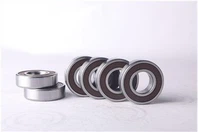
Hey there! As a supplier of 20mm Roller Bearings, I often get asked about the differences between 20mm ball bearings and 20mm roller bearings. So, I thought I'd write this blog to clear things up.
Let's start with the basics. Both ball bearings and roller bearings are types of rolling-element bearings. They're designed to reduce friction between moving parts in a machine. But they do it in different ways, and these differences can have a big impact on how they perform in different applications.
Design and Structure
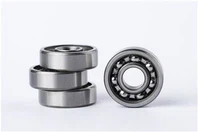
First off, let's talk about the design. A 20mm ball bearing uses spherical balls as its rolling elements. These balls are housed in a raceway, which is a groove in the inner and outer rings of the bearing. The balls roll freely in the raceway, allowing the inner and outer rings to rotate relative to each other with minimal friction.
On the other hand, a 20mm roller bearing uses cylindrical or tapered rollers instead of balls. These rollers are also housed in a raceway, but because of their shape, they have a larger contact area with the raceway compared to balls. This design difference is key to understanding how they perform differently.
Load Capacity
One of the most significant differences between the two is their load capacity. Due to the larger contact area, 20mm roller bearings can generally handle heavier radial and axial loads than 20mm ball bearings. Radial loads are those that act perpendicular to the axis of rotation, like the weight of a car wheel on its axle. Axial loads, on the other hand, act parallel to the axis of rotation, such as the thrust from a propeller.
If you're dealing with a high-load application, like in heavy machinery or industrial equipment, a 20mm roller bearing is often the better choice. For example, in a conveyor system that transports heavy goods, roller bearings can withstand the constant pressure and keep the system running smoothly.
However, if the load is relatively light, a 20mm ball bearing might be sufficient. Ball bearings are commonly used in applications like electric motors, where the loads are not as extreme, and high-speed rotation is required.
Speed and Friction
When it comes to speed, ball bearings have an edge. Because the balls have a smaller contact area with the raceway, there's less friction generated during rotation. This allows ball bearings to operate at higher speeds with less heat buildup. In high-speed applications, such as in a turbine or a high - performance electric motor, a 20mm ball bearing can provide better performance.
Roller bearings, with their larger contact area, generate more friction. This means they are generally not as well - suited for extremely high - speed applications. However, modern roller bearing designs have made significant improvements in reducing friction, and they can still operate at relatively high speeds in many industrial settings.


Noise and Vibration
Another aspect to consider is noise and vibration. Ball bearings tend to be quieter and produce less vibration during operation. This is because the spherical shape of the balls allows for a more uniform and smooth rolling motion. In applications where noise is a concern, like in home appliances or office equipment, ball bearings are often preferred.
Roller bearings, while they have improved in this area, can still produce more noise and vibration, especially under heavy loads. But in industrial environments where noise is less of an issue, and load capacity is the top priority, this might not be a deal - breaker.
Cost
Cost is always a factor in any purchasing decision. Generally, 20mm ball bearings are less expensive than 20mm roller bearings. This is because ball bearings are simpler in design and easier to manufacture. If cost is a major concern and the application doesn't require the high load - carrying capacity of a roller bearing, a ball bearing might be the more economical choice.
Applications
Let's look at some specific applications to see how these differences play out.
20mm Ball Bearings
- Electric Motors: As mentioned earlier, ball bearings are ideal for electric motors. They can handle the relatively light loads and allow the motor to run at high speeds with minimal friction and noise.
- Computer Hard Drives: In hard drives, where high - speed rotation and low vibration are crucial, ball bearings are used to ensure smooth operation and accurate data reading and writing.
- Skateboards and Rollerblades: Ball bearings in these sports equipment allow for smooth and fast movement, enabling skaters to perform tricks and move at high speeds.
20mm Roller Bearings
- Automotive Industry: In cars, roller bearings are used in wheel hubs, transmissions, and differentials. They can handle the heavy loads and forces generated during driving, ensuring the reliability and safety of the vehicle.
- Industrial Machinery: From manufacturing equipment to mining machinery, roller bearings are widely used because of their high load - carrying capacity. They can withstand the harsh operating conditions and heavy loads in these industries.
- Agricultural Equipment: Tractors and other agricultural machinery rely on roller bearings to handle the heavy loads and rough terrain.
Why Choose Our 20mm Roller Bearings
As a supplier of 20mm Roller Bearing, I can tell you that our products are top - notch. We use high - quality materials and advanced manufacturing processes to ensure that our roller bearings have excellent load - carrying capacity, low friction, and long service life.
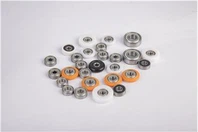
Our Small Rollers with Bearings are designed to meet the diverse needs of different industries. Whether you're in the automotive, industrial, or agricultural sector, we have the right roller bearing for you. And if you're looking for a specific type of bearing, like the Bearing 6203llu, we can provide it with high - quality assurance.
Contact Us for Purchasing
If you're interested in purchasing 20mm roller bearings or have any questions about the differences between ball and roller bearings, don't hesitate to reach out. We're here to help you make the right choice for your application. Whether you need a small quantity for a prototype or a large order for a production line, we can meet your requirements.
References
- "Rolling Bearing Analysis" by Tedric A. Harris
- "Mechanical Design Handbook" by Robert C. Juvinall and Kurt M. Marshek
- Industry publications from bearing manufacturers and associations