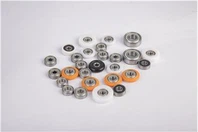
Hey there! As a supplier of U Type Groove Pulleys, I often get asked about all sorts of technical aspects of these nifty little components. One question that pops up quite a bit is, "What is the coefficient of restitution of a U Type Groove Pulley?" Let's dive right into it and break it down in a way that's easy to understand.
First off, let's talk about what the coefficient of restitution actually is. In simple terms, it's a measure of how bouncy an object is when it collides with another. It's a number between 0 and 1. A coefficient of 0 means the object doesn't bounce at all - it just sticks to the other object upon impact. On the other hand, a coefficient of 1 means a perfectly elastic collision, where all the kinetic energy is conserved and the object bounces back with the same speed it hit the other object.
Now, when it comes to a U Type Groove Pulley, the coefficient of restitution isn't something that's as straightforward as it might be for a ball or a simple object. U Type Groove Pulleys are used in all sorts of applications, from industrial machinery to garage doors. They're designed to guide and support belts or ropes, and their interaction with these components is a bit more complex than a simple collision.
The coefficient of restitution of a U Type Groove Pulley depends on several factors. One of the main factors is the material the pulley is made of. Different materials have different elastic properties. For example, a pulley made of a hard plastic might have a different coefficient of restitution compared to one made of metal. Metals are generally more elastic than plastics, so they tend to have a higher coefficient of restitution.
Another factor is the surface finish of the pulley. A smooth surface will allow the belt or rope to glide more easily, which can affect the way the pulley responds to any impacts or vibrations. If the surface is rough, there might be more friction, which can reduce the coefficient of restitution.


The design of the U Type Groove also plays a role. The shape and depth of the groove can influence how the belt or rope interacts with the pulley. A deeper groove might provide more stability, but it could also change the way the pulley behaves during operation, potentially affecting the coefficient of restitution.
In industrial applications, where U Type Groove Pulleys are often used in conjunction with Industrial Roller Bearings, the coefficient of restitution can impact the overall performance of the system. If the coefficient is too low, there might be more energy loss during operation, which can lead to increased wear and tear on the components. On the other hand, if the coefficient is too high, it could cause excessive vibrations or instability in the system.
Let's take a look at a real - world example. In a garage door system, 6200zz Garage Door Rollers and U Type Groove Pulleys work together to ensure smooth operation. The coefficient of restitution of the U Type Groove Pulley can affect how the door opens and closes. If the coefficient is just right, the door will open and close quietly and smoothly, with minimal noise and wear on the components.
Measuring the coefficient of restitution of a U Type Groove Pulley isn't an easy task. It usually requires specialized equipment and a controlled environment. You'd need to set up an experiment where you can accurately measure the speed of the belt or rope before and after it interacts with the pulley. This data can then be used to calculate the coefficient of restitution using the appropriate formula.
As a supplier of U Type Groove Pulleys, I understand the importance of getting these technical details right. That's why we work closely with our manufacturing partners to ensure that our pulleys are made to the highest standards. We test our products rigorously to make sure they perform as expected in real - world applications.
If you're in the market for U Type Groove Pulleys, it's important to consider the coefficient of restitution and how it might affect your specific application. Whether you're building a large - scale industrial machine or just looking to replace the pulleys in your garage door, choosing the right pulley with the appropriate coefficient of restitution can make a big difference in the performance and longevity of your system.
So, if you have any questions about U Type Groove Pulleys or need help selecting the right one for your project, don't hesitate to reach out. We're here to help you make the best choice for your needs. Whether it's understanding the coefficient of restitution or any other technical aspect, we've got the expertise to guide you through the process.
In conclusion, the coefficient of restitution of a U Type Groove Pulley is a complex but important factor that can impact the performance of various systems. By understanding the factors that influence it and working with a reliable supplier, you can ensure that your U Type Groove Pulley meets your requirements and provides long - lasting, efficient operation. If you're interested in purchasing U Type Groove Pulleys, we'd love to have a chat with you about your needs. Let's start a conversation and find the perfect solution for your project.
References
- "Engineering Mechanics: Dynamics" by J.L. Meriam and L.G. Kraige
- "Mechanical Design Handbook" by Robert C. Juvinall and Kurt M. Marshek