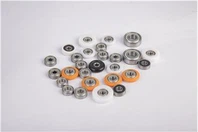
Hey there! As a supplier of Bearing 6305, I often get asked about how to predict the fatigue life of these bearings. It's a crucial question, especially for those who rely on these bearings in their machinery. So, let's dive right in and explore the ins and outs of predicting the fatigue life of Bearing 6305.
First off, what is Bearing 6305? Bearing 6305 is a type of middle - size roller bearing that's widely used in various industrial applications. It's designed to handle radial loads and, to some extent, axial loads. Its popularity stems from its durability and performance in demanding environments.
Now, let's talk about fatigue life. Fatigue in bearings occurs when the material is subjected to repeated stress over time. Eventually, small cracks form, and these can grow until the bearing fails. Predicting the fatigue life helps in maintenance planning, reducing downtime, and ensuring the overall reliability of the machinery.
Factors Affecting Fatigue Life
There are several factors that can influence the fatigue life of Bearing 6305.
Load
The load on the bearing is one of the most significant factors. The greater the load, the shorter the fatigue life. Bearings are rated for a specific dynamic load capacity, which is the load that a bearing can withstand for a million revolutions with a 90% probability of survival. When calculating the fatigue life, we need to consider both the radial and axial loads acting on the Bearing 6305.
Speed
The rotational speed of the bearing also plays a role. Higher speeds can generate more heat and increase the rate of wear. As the speed goes up, the lubricant may not be able to form an effective film between the rolling elements and the raceways, leading to increased friction and a shorter fatigue life.
Lubrication
Proper lubrication is essential for bearing performance and fatigue life. A good lubricant reduces friction, dissipates heat, and protects the bearing surfaces from corrosion. The type of lubricant, its viscosity, and the lubrication method all impact the fatigue life. For example, if the lubricant is too thin, it may not provide adequate protection under high loads. On the other hand, if it's too thick, it can cause excessive drag and heat generation.
Operating Temperature
Temperature has a significant effect on the fatigue life of bearings. High temperatures can break down the lubricant, reduce its effectiveness, and cause thermal expansion of the bearing components. This can lead to changes in the internal clearances of the bearing, increasing the stress on the rolling elements and raceways. Generally, for every 10°C increase in operating temperature above the normal range, the fatigue life of the bearing can be halved.
Material Quality
The quality of the bearing material also matters. High - quality materials are more resistant to fatigue and wear. Bearing 6305 is typically made from high - grade steel, but variations in the manufacturing process can affect the material's properties. For instance, impurities in the steel can act as stress concentration points, increasing the likelihood of crack initiation.
Calculation Methods for Fatigue Life
There are a few methods used to predict the fatigue life of bearings.
ISO 281 Standard
The ISO 281 standard is one of the most widely used methods for calculating the basic rating life of bearings. The basic rating life $L_{10}$ is defined as the number of revolutions or hours that 90% of a group of identical bearings will complete or exceed before the first evidence of fatigue failure under a given load and operating conditions.

The formula for the basic rating life in revolutions is:
$L_{10}=\left(\frac{C}{P}\right)^{\epsilon}$
where $C$ is the dynamic load capacity of the bearing, $P$ is the equivalent dynamic load, and $\epsilon$ is an exponent. For ball bearings, $\epsilon = 3$, and for roller bearings, $\epsilon=\frac{10}{3}$.
To convert the life from revolutions to hours, we use the formula:
$L_{10h}=\frac{L_{10}}{60n}$
where $n$ is the rotational speed of the bearing in revolutions per minute.
However, the ISO 281 standard only provides a basic estimate. It doesn't take into account all the real - world factors such as lubrication, contamination, and material quality.
Weibull Analysis
Weibull analysis is a statistical method that can provide a more accurate prediction of bearing fatigue life. It takes into account the distribution of failures in a population of bearings. By analyzing data from tests or field experience, we can estimate the Weibull parameters, which describe the shape and scale of the failure distribution. This method allows us to calculate the probability of failure at different times and loads, giving a more comprehensive picture of the bearing's fatigue life.
Predictive Maintenance and Real - Time Monitoring
Predictive maintenance techniques can also be used to predict the fatigue life of Bearing 6305 more accurately.
Vibration Analysis
Vibration analysis involves monitoring the vibration levels of the bearing during operation. As the bearing starts to develop fatigue cracks, the vibration patterns change. By analyzing these changes, we can detect early signs of fatigue and estimate how much life is left in the bearing. Specialized sensors are used to measure the vibration, and advanced signal processing techniques are employed to analyze the data.
Oil Analysis
Oil analysis is another useful tool. By analyzing the lubricant for wear particles, contaminants, and changes in its chemical properties, we can get an idea of the bearing's condition. For example, the presence of large metal particles in the oil may indicate excessive wear in the bearing. Regular oil sampling and analysis can help in predicting when the bearing is likely to fail.
Temperature Monitoring
Monitoring the operating temperature of the bearing can also provide valuable information. An increase in temperature can be a sign of impending failure. Temperature sensors can be installed near the bearing to continuously monitor its temperature. If the temperature rises above a certain threshold, it may be time to inspect the bearing or take preventive measures.
As a Supplier, How We Can Help
As a supplier of Bearing 6305, we can offer a lot of support in predicting the fatigue life of these bearings.
We have in - house experts who are well - versed in bearing technology and fatigue life calculations. They can help our customers analyze their specific operating conditions, including load, speed, lubrication, and temperature, and provide accurate estimates of the bearing's fatigue life.
We also provide high - quality Bearing 6305 products. Our bearings are manufactured using the latest technology and strict quality control measures to ensure the best material quality and performance. We can offer advice on the proper selection of lubricants and lubrication methods to maximize the bearing's fatigue life.
In addition, we can assist with predictive maintenance programs. We can recommend the appropriate monitoring equipment and techniques, and help our customers interpret the data obtained from these monitoring systems.
If you're in need of Bearing 6305 or have questions about predicting the fatigue life of these bearings, don't hesitate to reach out. We're here to help you make the most of your bearing applications and ensure the long - term reliability of your machinery. Whether you're a small - scale manufacturer or a large industrial enterprise, we have the expertise and products to meet your needs.
Conclusion
Predicting the fatigue life of Bearing 6305 is a complex but essential task. By considering factors such as load, speed, lubrication, temperature, and material quality, and using appropriate calculation methods and predictive maintenance techniques, we can get a better understanding of how long the bearing will last. As a supplier, we're committed to providing our customers with the knowledge and products they need to optimize the performance and fatigue life of Bearing 6305. If you're interested in learning more or making a purchase, feel free to contact us for a detailed discussion.
References
- ISO 281:2007, Rolling bearings - Dynamic load ratings and rating life
- Harris, T. A., & Kotzalas, M. N. (2007). Rolling Bearing Analysis. John Wiley & Sons.
- Zaretsky, E. V. (2007). Ball and Roller Bearing Engineering. CRC Press.