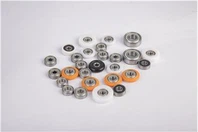
Vibration analysis is a powerful tool in the field of mechanical maintenance, especially when it comes to diagnosing pulley bearing problems. As a leading supplier of pulley bearings, including Paper Roller Bearing, Industrial Roller Bearings, and Door Bearing Wheels, I have witnessed firsthand the importance of accurate diagnosis. In this blog, I will share insights on how to effectively use vibration analysis to detect and troubleshoot pulley bearing issues.
Understanding the Basics of Vibration in Pulley Bearings
Before delving into the diagnostic process, it is crucial to understand why pulley bearings vibrate. In an ideal scenario, a pulley bearing should rotate smoothly with minimal vibration. However, various factors can cause abnormal vibrations. These include manufacturing defects, improper installation, wear and tear, and contamination.
When a bearing is in good condition, the vibration levels are relatively low and stable. But as problems develop, the vibration patterns change. For example, a damaged raceway in the bearing can cause irregular impacts as the rolling elements pass over the defect. This results in an increase in vibration amplitude at specific frequencies related to the bearing's geometry and rotational speed.
The Importance of Vibration Analysis
Vibration analysis offers several advantages for diagnosing pulley bearing problems. Firstly, it is a non - invasive method. You can measure the vibrations without disassembling the bearing, which saves time and reduces the risk of further damage during disassembly. Secondly, it allows for early detection of problems. By monitoring the vibration levels and patterns over time, you can identify the onset of issues before they lead to complete bearing failure. This proactive approach can prevent costly downtime and production losses.
Tools for Vibration Analysis
To perform vibration analysis, you need the right tools. A basic vibration analyzer consists of a vibration sensor (usually an accelerometer) and a data acquisition unit. The accelerometer is attached to the bearing housing, and it measures the acceleration of the vibrations. The data acquisition unit then records and analyzes the vibration signals.
There are also more advanced vibration analysis systems available that can provide real - time monitoring and detailed spectral analysis. These systems can be integrated into the industrial control network, allowing for continuous monitoring of multiple bearings simultaneously.
Steps in Vibration Analysis for Pulley Bearings
Step 1: Baseline Measurement
The first step is to establish a baseline vibration measurement for the pulley bearing when it is in good condition. This measurement should be taken under normal operating conditions, including the correct speed, load, and temperature. By comparing future measurements to this baseline, you can easily detect any changes in the vibration characteristics.
Step 2: Regular Monitoring
Once the baseline is established, regular monitoring of the bearing's vibration levels is essential. The frequency of monitoring depends on the application and the criticality of the bearing. For high - speed or high - load applications, more frequent monitoring may be required.
Step 3: Data Analysis
After collecting the vibration data, the next step is to analyze it. One of the most common methods is frequency analysis. By converting the time - domain vibration signal into the frequency domain using techniques such as the Fast Fourier Transform (FFT), you can identify the specific frequencies at which the vibration amplitudes are high.
For pulley bearings, certain frequencies are associated with different types of problems. For example, the ball pass frequency outer race (BPFO) can indicate damage to the outer race of the bearing. Similarly, the ball pass frequency inner race (BPFI) is related to inner race defects. By comparing the measured frequencies with the theoretical values calculated based on the bearing's specifications, you can determine the likely source of the problem.
Step 4: Trend Analysis
In addition to frequency analysis, trend analysis is also important. By plotting the vibration amplitudes over time, you can observe how the bearing's condition is changing. An increasing trend in vibration amplitude at a particular frequency may indicate the progression of a problem.


Interpreting Vibration Analysis Results
Interpreting the results of vibration analysis requires experience and knowledge of bearing dynamics. A single high - amplitude vibration peak at a specific frequency may not necessarily mean a serious problem. It could be due to a temporary disturbance or a normal operating characteristic.
However, if multiple frequencies show abnormal increases in amplitude, or if the vibration levels exceed the predefined alarm limits, it is a strong indication of a bearing problem. For example, if the BPFO frequency has a significantly higher amplitude than the baseline, it is likely that there is damage to the outer race of the bearing.
Common Problems and Their Vibration Signatures
- Wear and Tear: As a bearing wears over time, the vibration levels gradually increase across a wide range of frequencies. This is because the clearances between the rolling elements and the raceways increase, leading to more random motion and higher vibration.
- Contamination: Contamination, such as dirt or debris in the bearing, can cause erratic vibrations. The contaminants can interfere with the smooth rolling of the elements, resulting in sudden spikes in the vibration signal.
- Misalignment: If the pulley and the bearing are misaligned, it can cause additional forces on the bearing. This leads to an increase in vibration at frequencies related to the rotational speed and the misalignment angle.
Preventive Measures Based on Vibration Analysis
Once you have diagnosed a problem through vibration analysis, you can take appropriate preventive measures. If the problem is minor, such as a small amount of contamination, you may be able to clean the bearing and replace the lubricant. For more serious problems, such as a damaged raceway, it may be necessary to replace the bearing.
Regular maintenance schedules should also be adjusted based on the results of vibration analysis. For example, if a bearing shows signs of accelerated wear, the lubrication intervals may need to be shortened, or the bearing may need to be inspected more frequently.
Conclusion
Vibration analysis is an invaluable tool for diagnosing pulley bearing problems. By understanding the basics of vibration in bearings, using the right tools, and following a systematic approach to analysis, you can identify and address issues before they cause major problems.
As a supplier of high - quality pulley bearings, including Paper Roller Bearing, Industrial Roller Bearings, and Door Bearing Wheels, I am committed to helping our customers maintain their equipment in the best possible condition. If you have any questions about vibration analysis or need assistance in selecting the right bearing for your application, we encourage you to reach out to us for further discussion and potential procurement.
References
- Cempel, C., & Redlein, F. (2009). Vibration - based Condition Monitoring: Industrial Applications. Wiley.
- Randall, R. B., & Antoni, J. (2011). Machine Condition Monitoring: Theory, Techniques, and Applications. Wiley.