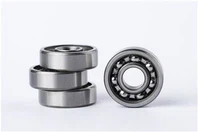
As a supplier of Bearing 6200, I've witnessed firsthand the intricate relationship between frequency response and the high - speed operation of this crucial component. In this blog, I'll delve into how frequency response affects the high - speed operation of Bearing 6200, drawing on industry knowledge and practical experience.
Understanding Frequency Response in Bearings
Frequency response in bearings refers to how a bearing responds to different frequencies of vibration and dynamic loads. When a bearing is in operation, it is subjected to various forces that cause it to vibrate. These vibrations have different frequencies, and the bearing's ability to handle these frequencies without significant degradation in performance is what we call its frequency response.
In the case of Bearing 6200, a small - sized ball bearing with a wide range of applications, the frequency response characteristics play a vital role in its high - speed operation. High - speed operation means that the bearing is rotating at a relatively high angular velocity, which generates more complex dynamic forces and vibrations compared to low - speed operation.


Impact on Vibration and Noise
One of the most noticeable effects of frequency response on the high - speed operation of Bearing 6200 is its influence on vibration and noise. At high speeds, the bearing's rolling elements, such as balls, interact with the raceways at a faster rate. If the bearing's frequency response is not well - matched to the operating conditions, it can lead to excessive vibration.
Excessive vibration not only affects the smoothness of the machine's operation but also generates noise. For industrial applications where quiet operation is essential, such as in precision machinery or home appliances, this can be a significant drawback. For example, in a high - speed electric motor using Bearing 6200, if the bearing vibrates excessively due to a poor frequency response, it can cause the motor to produce a loud, annoying noise. This not only reduces the user experience but may also indicate potential damage to the bearing or other components in the long run.
Fatigue Life and Wear
Frequency response also has a profound impact on the fatigue life and wear of Bearing 6200 during high - speed operation. When the bearing is subjected to dynamic loads at frequencies that are not within its optimal response range, it can lead to uneven stress distribution on the rolling elements and raceways.
This uneven stress distribution accelerates the wear process. The rolling elements may experience more friction and impact forces, causing them to wear out faster. Over time, this can lead to a reduction in the bearing's fatigue life. A bearing with a shorter fatigue life means more frequent replacements, which increases maintenance costs and downtime for the equipment. For instance, in a high - speed conveyor system, if the Bearing 6200 fails prematurely due to wear caused by poor frequency response, the entire conveyor system may need to be shut down for replacement, resulting in significant production losses.
Lubrication and Heat Generation
Another aspect affected by frequency response is the lubrication and heat generation in Bearing 6200 during high - speed operation. At high speeds, the lubricant in the bearing plays a crucial role in reducing friction and dissipating heat. However, if the frequency response of the bearing causes excessive vibration and uneven loading, it can disrupt the lubricant film.
A disrupted lubricant film means that there is less effective lubrication between the rolling elements and the raceways. This increases friction, which in turn generates more heat. High temperatures can degrade the lubricant, reducing its effectiveness and further accelerating wear. In extreme cases, overheating can even cause the bearing to seize, leading to catastrophic failure. For example, in a high - speed spindle of a machine tool, if the Bearing 6200 overheats due to poor frequency - related lubrication issues, it can damage the spindle and other critical components, resulting in expensive repairs.
Matching Frequency Response to High - Speed Operation
To ensure optimal high - speed operation of Bearing 6200, it is essential to match its frequency response to the specific operating conditions. This involves careful consideration of factors such as the rotational speed, load magnitude, and type of application.
For high - speed applications, bearings with a wider frequency response range are often preferred. These bearings can better handle the complex dynamic forces and vibrations associated with high - speed rotation. Additionally, proper lubrication selection is crucial. High - speed bearings require lubricants with good high - temperature stability and anti - wear properties to maintain an effective lubricant film under the influence of various frequencies.
Moreover, the design and manufacturing process of the bearing also play a role in improving frequency response. Advanced manufacturing techniques can ensure more precise dimensions and surface finishes, which help to reduce vibration and improve the bearing's ability to handle different frequencies.
Comparison with Other Small Bearings
When considering the frequency response and high - speed operation of Bearing 6200, it's interesting to compare it with other small bearings, such as Bearing 6001ZZ. While both are small - sized ball bearings, they may have different frequency response characteristics due to differences in their design and dimensions.
Bearing 6200 has a relatively larger outer diameter and a higher load - carrying capacity compared to Bearing 6001ZZ. This means that it can potentially handle higher dynamic loads and frequencies during high - speed operation. However, the specific application requirements will ultimately determine which bearing is more suitable. For applications where space is extremely limited and lower loads are involved, Bearing 6001ZZ may be a better choice, despite its potentially different frequency response behavior.
Conclusion and Call to Action
In conclusion, the frequency response of Bearing 6200 has a far - reaching impact on its high - speed operation. From vibration and noise to fatigue life, wear, lubrication, and heat generation, every aspect of the bearing's performance is influenced by how well it responds to different frequencies.
As a supplier of Bearing 6200, I understand the importance of providing high - quality bearings that are optimized for high - speed operation. We have a wide range of small bearings, including Small Bearings, and we are committed to helping our customers find the right bearings for their specific applications.
If you are in need of Bearing 6200 or other small bearings for your high - speed operation, I encourage you to reach out for a detailed consultation. We can provide you with technical support, product recommendations, and competitive pricing. Let's work together to ensure the smooth and efficient operation of your equipment.
References
- Harris, T. A., & Kotzalas, M. N. (2007). Rolling Bearing Analysis. Wiley.
- Palmgren, A. (1947). Die Lebensdauer von Kugellagern. Springer - Verlag.
- SKF Rolling Bearing Handbook. (2010). SKF Group.