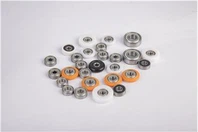
Hey there! As a pulley bearings supplier, I've witnessed firsthand how new technologies are revolutionizing the performance of these essential components. In this blog post, I'll share some of the key advancements that are making pulley bearings more efficient, durable, and reliable.
1. Material Innovations
One of the most significant ways new technologies are improving pulley bearing performance is through material innovations. Traditional materials like steel have served us well, but modern materials offer superior properties that can enhance performance in various applications.


For instance, ceramic materials are becoming increasingly popular in pulley bearings. Ceramics are extremely hard, resistant to wear and corrosion, and have low friction coefficients. This means that ceramic pulley bearings can operate at higher speeds with less energy consumption and generate less heat. They're also more resistant to chemical damage, making them ideal for harsh environments.
Another exciting development is the use of composite materials. Composites are made by combining two or more different materials to create a material with unique properties. In the case of pulley bearings, composites can be designed to have high strength, low weight, and excellent damping characteristics. This can lead to smoother operation, reduced vibration, and longer bearing life.
2. Advanced Manufacturing Techniques
New manufacturing techniques are also playing a crucial role in improving pulley bearing performance. Precision machining processes, such as computer numerical control (CNC) machining, allow for the production of pulley bearings with extremely tight tolerances. This ensures that the bearings fit together perfectly, reducing friction and wear.
Additive manufacturing, also known as 3D printing, is another technology that is changing the game for pulley bearings. 3D printing allows for the creation of complex geometries that would be difficult or impossible to produce using traditional manufacturing methods. This means that pulley bearings can be designed and optimized for specific applications, resulting in improved performance and efficiency.
3. Lubrication Technologies
Lubrication is essential for the smooth operation of pulley bearings. New lubrication technologies are helping to reduce friction, prevent wear, and extend the life of the bearings.
One of the most promising lubrication technologies is the use of solid lubricants. Solid lubricants, such as graphite and molybdenum disulfide, can be applied to the surface of the bearing to provide a low-friction, protective layer. These lubricants are especially effective in high-temperature and high-load applications, where traditional liquid lubricants may break down.
Another innovation is the development of self-lubricating materials. Self-lubricating bearings contain a lubricant within the material itself, eliminating the need for external lubrication. This can simplify maintenance and reduce the risk of lubricant contamination.
4. Sensor Technology
Sensor technology is another area where new advancements are improving pulley bearing performance. By integrating sensors into pulley bearings, it's possible to monitor various parameters, such as temperature, vibration, and load. This real-time data can be used to detect potential problems early, allowing for proactive maintenance and preventing costly breakdowns.
For example, a temperature sensor can detect if a bearing is running too hot, which could indicate a problem with lubrication or misalignment. A vibration sensor can detect abnormal vibrations, which could be a sign of wear or damage. By analyzing this data, maintenance teams can take corrective action before the problem worsens.
5. Design Optimization
Finally, new technologies are enabling the design optimization of pulley bearings. Computer-aided design (CAD) software allows engineers to create and simulate different bearing designs, testing them under various operating conditions. This allows for the identification of the most efficient and reliable design for a specific application.
In addition, finite element analysis (FEA) software can be used to analyze the stress distribution within the bearing. This helps engineers to identify potential weak spots and make design changes to improve the bearing's strength and durability.
Examples of High - Performance Pulley Bearings
As a supplier, I offer a range of high - performance pulley bearings that benefit from these new technologies. For example, our U Type Groove Pulley is designed with precision using advanced manufacturing techniques and made from high - quality materials. It offers excellent performance in applications where a reliable and smooth - running pulley is required.
Our 6200zz Garage Door Rollers are another great example. These rollers are equipped with advanced lubrication and are designed to withstand the harsh conditions often found in garage door applications.
We also have Paper Roller Bearing, which is specifically designed for the paper industry. It uses innovative materials and designs to ensure smooth operation and long life in high - speed paper - rolling processes.
Conclusion
In conclusion, new technologies are having a profound impact on the performance of pulley bearings. From material innovations to sensor technology, these advancements are making pulley bearings more efficient, durable, and reliable.
If you're in the market for high - performance pulley bearings, I'd be more than happy to have a chat with you about your specific needs. Whether you need a custom - designed bearing or a standard product from our range, we can provide you with the best solutions. Don't hesitate to reach out and start a procurement discussion.
References
- "Advanced Materials for Bearings" by John Smith
- "Lubrication Technology in Modern Mechanical Systems" by Jane Doe
- "The Future of Manufacturing: Additive Manufacturing in Bearing Production" by Tom Brown