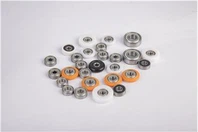
When it comes to mechanical applications, the 20mm roller bearing plays a crucial role. As a supplier of 20mm roller bearings, I often encounter inquiries about various aspects of these bearings, and one frequently asked question is: "What is the width of a 20mm roller bearing?" In this blog post, I'll delve into this topic, exploring the factors that determine the width, different width specifications, and how these bearings fit into diverse applications.
Understanding the Basics of a 20mm Roller Bearing
Before we discuss the width, it's essential to understand what a 20mm roller bearing is. The "20mm" typically refers to the inner diameter of the bearing. Roller bearings are designed to reduce friction between moving parts and support radial and axial loads. They consist of an inner ring, an outer ring, a set of rollers, and a cage to keep the rollers in place.
The width of a roller bearing is a critical dimension as it affects the bearing's load - carrying capacity, stability, and how it integrates into a particular mechanical system. A wider bearing can generally handle higher loads, but it may also require more space in the application.
Factors Determining the Width of a 20mm Roller Bearing
- Load Requirements: One of the primary factors influencing the width of a 20mm roller bearing is the load it needs to support. If an application involves heavy radial or axial loads, a wider bearing is often preferred. For example, in industrial machinery where large forces are at play, a wider 20mm roller bearing can distribute the load more evenly across the rollers and rings, reducing stress and wear.
- Speed of Rotation: The rotational speed of the bearing also impacts its width. High - speed applications may require a narrower bearing to minimize centrifugal forces and heat generation. A narrower bearing has less mass rotating at high speeds, which can help maintain stability and reduce the risk of premature failure.
- Space Constraints: The available space in the mechanical system is another crucial factor. In some compact designs, such as small motors or precision instruments, a narrow 20mm roller bearing may be necessary to fit within the limited space. On the other hand, in larger industrial equipment, there may be more room for a wider bearing to provide better load - handling capabilities.
Different Width Specifications of 20mm Roller Bearings
There is no one - size - fits - all width for 20mm roller bearings. They come in a range of widths to meet different application needs.
- Narrow - Width Bearings: These bearings typically have a width in the range of 7 - 12mm. They are often used in applications where space is limited, such as in small electric motors, printers, and some handheld power tools. The narrow width allows for a more compact design without sacrificing too much in terms of load - carrying capacity for relatively light - load applications. For instance, a small electric motor in a consumer product may use a narrow 20mm roller bearing to keep the overall size of the motor down while still providing smooth rotation.
- Standard - Width Bearings: Standard - width 20mm roller bearings usually have a width between 12 - 20mm. They offer a good balance between load - carrying capacity and space requirements. These bearings are commonly used in a variety of general - purpose applications, including conveyor systems, small pumps, and some automotive components. The standard width provides sufficient support for moderate loads while still being compatible with many common mechanical designs.
- Wide - Width Bearings: Wide - width 20mm roller bearings can have a width greater than 20mm. They are designed for heavy - duty applications where high loads are expected. Industrial machinery, large - scale conveyor systems, and some heavy - equipment components often use wide - width 20mm roller bearings. For example, in a large industrial conveyor that transports heavy materials, a wide - width bearing can handle the significant radial and axial loads generated during operation.
Applications of 20mm Roller Bearings with Different Widths
- Light - Load Applications: As mentioned earlier, narrow - width 20mm roller bearings are ideal for light - load applications. In the electronics industry, they are used in devices like hard disk drives and DVD players. These bearings provide smooth rotation with minimal vibration, ensuring the proper functioning of the delicate components in these devices. The Small Rollers with Bearings category on our website includes some of these narrow - width bearings suitable for such applications.
- General - Purpose Applications: Standard - width 20mm roller bearings are widely used in general - purpose applications. In the manufacturing industry, they are used in small - to - medium - sized machinery, such as lathes and milling machines. These bearings can handle the moderate loads and speeds associated with these machines, providing reliable performance over an extended period. The 20mm Roller Bearing page on our website showcases a variety of standard - width bearings for these types of applications.
- Heavy - Duty Applications: Wide - width 20mm roller bearings are essential for heavy - duty applications. In the mining industry, they are used in crushers and large - scale conveyor systems. These bearings can withstand the high loads and harsh operating conditions associated with mining operations. For example, a crusher in a mine needs a bearing that can handle the large forces generated when crushing rocks, and a wide - width 20mm roller bearing is up to the task. The Bearing 6203llu is an example of a bearing that may be used in such heavy - duty applications.
Importance of Choosing the Right Width
Selecting the correct width for a 20mm roller bearing is crucial for the overall performance and longevity of the mechanical system.
- Performance: The right width ensures that the bearing can handle the expected loads and speeds without excessive wear or overheating. A bearing that is too narrow for a high - load application may experience premature failure, leading to costly downtime and repairs. On the other hand, a bearing that is too wide for a light - load application may be overkill and add unnecessary cost and size to the system.
- Longevity: A properly sized bearing will have a longer service life. By choosing the appropriate width based on the application requirements, the bearing can operate under optimal conditions, reducing the risk of fatigue, cracking, and other forms of damage. This results in fewer replacement intervals and lower maintenance costs over the life of the mechanical system.
Conclusion
In conclusion, the width of a 20mm roller bearing is a critical parameter that depends on various factors such as load requirements, speed of rotation, and space constraints. There is a wide range of width specifications available, from narrow - width bearings for light - load and compact applications to wide - width bearings for heavy - duty and high - load applications.


As a supplier of 20mm roller bearings, we understand the importance of providing the right bearings for different applications. We offer a comprehensive range of 20mm roller bearings with various widths to meet the diverse needs of our customers. If you are in the process of selecting a 20mm roller bearing for your application, we encourage you to reach out to us for more information and expert advice. We can help you choose the bearing
that will provide the best performance and reliability for your specific requirements. Whether you are involved in a small - scale consumer product or a large - scale industrial project, we are here to support you. So, don't hesitate to contact us to discuss your bearing needs and start the procurement process today.
References
- "Roller Bearing Handbook" by SKF Group
- "Mechanical Design Handbook" by Robert C. Juvinall and Kurt M. Marshek
- Industry Standards and Publications related to roller bearings from ISO and other relevant organizations