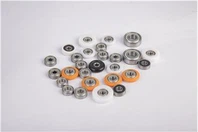
As a supplier of 608 roller bearings, I am often asked about the tolerance class of these bearings. Understanding the tolerance class is crucial for various applications as it directly impacts the bearing's performance and suitability for specific tasks. In this blog, I'll delve into what the tolerance class of a 608 roller bearing is, its significance, and how it affects your operations.
What is Bearing Tolerance Class?
Bearing tolerance class refers to a set of specific allowable deviations from ideal dimensions and geometric forms. These deviations are carefully defined by international standards such as those from the International Organization for Standardization (ISO) and the American Bearing Manufacturers Association (ABMA). Tolerance classes ensure that bearings are manufactured to a consistent level of precision, which is essential for the proper functioning of machinery where they are installed.
The tolerance class of a bearing affects several key aspects, including its radial and axial runout, bore and outside - diameter dimensions, and width. A lower tolerance class number indicates a higher level of precision. For instance, a bearing with a tolerance class of P2 (in the ISO system) is more precise than one with a class of P5.
Tolerance Class of 608 Roller Bearings
The 608 roller bearing is a popular Mini Roller Bearings known for its wide range of applications, especially in small - scale machinery. It has a bore diameter of 8 mm, an outer diameter of 22 mm, and a width of 7 mm.
The most common tolerance classes for 608 roller bearings are P0, P6, and P5, with P0 being the most basic and widely used.
-
P0 Tolerance Class: This is the standard tolerance class for general - purpose applications. Bearings in this class have relatively larger allowable deviations in dimensions and geometric forms. They are suitable for most common applications where high precision is not a critical requirement, such as in toys, small fans, and some light - duty conveyor systems. The P0 class offers a good balance between cost and performance, making it a popular choice for mass - produced products.
-
P6 Tolerance Class: Bearings with a P6 tolerance class have a higher level of precision compared to P0. The allowable deviations in dimensions and form are smaller, which results in better running accuracy. P6 class 608 roller bearings are often used in applications where moderate precision is required, such as in some power tools, small electric motors, and gyroscopic devices.
-
P5 Tolerance Class: P5 class bearings are even more precise than P6. They have extremely tight dimensional tolerances and better geometric accuracy. These bearings are used in applications that demand high - precision operation, like in some optical instruments, high - speed spindle systems, and precision measuring equipment.
Why Tolerance Class Matters
The choice of the tolerance class for a 608 roller bearing can significantly impact the performance and longevity of the entire machinery.
-
Precision and Accuracy: In applications where high precision is required, such as in a milling machine or a coordinate measuring machine, using a bearing with an appropriate tolerance class is essential. A bearing with a low precision class may lead to inaccurate positioning, vibration, and reduced surface finish quality on the machined parts.
-
Noise and Vibration: Higher - precision bearings generally produce less noise and vibration during operation. In applications like home appliances or audio equipment, minimizing noise is crucial for user comfort. Using a bearing with a suitable tolerance class can help reduce unwanted noise and vibration, enhancing the overall user experience.
-
Load - Carrying Capacity: The dimensional accuracy of a bearing can also affect its load - carrying capacity. A bearing with precise dimensions distributes the load more evenly across its rolling elements, which can increase its durability and reduce the risk of premature failure under heavy loads.
Selecting the Right Tolerance Class for Your 608 Roller Bearing
When choosing the tolerance class for your 608 Roller Bearing, you need to consider several factors:


-
Application Requirements: Determine the level of precision required by your application. If your machinery needs to operate with high accuracy, you may need to choose a higher - precision bearing such as P5. For less critical applications, a P0 or P6 class bearing may be sufficient.
-
Operating Speed: Higher - speed applications often require bearings with stricter tolerance classes. At high speeds, even small dimensional deviations can cause significant vibration and heat generation, which can lead to premature bearing failure.
-
Budget Constraints: Higher - precision bearings are generally more expensive due to the additional manufacturing processes and quality control measures required. You need to balance the need for precision with your budget. Sometimes, a slightly lower - precision bearing may still meet the requirements of your application at a lower cost.
Our Capabilities as a 608 Roller Bearing Supplier
As a supplier of 608 roller bearings, we offer a wide range of tolerance classes to meet the diverse needs of our customers. We have a strict quality control system in place to ensure that each bearing meets the specified tolerance requirements. Our manufacturing processes are designed to produce bearings with high precision and reliability.
We also have a team of experienced engineers who can provide technical support and advice on selecting the right tolerance class for your specific application. Whether you need a large quantity of P0 class bearings for a mass - production project or a small batch of P5 class bearings for a high - precision instrument, we can meet your requirements.
In addition to 608 Roller Bearings, we also supply Micro Roller Bearings and other types of miniature bearings. Our product portfolio is extensive, and we are committed to providing high - quality products and excellent customer service.
Conclusion
The tolerance class of a 608 roller bearing is a critical factor that affects its performance and suitability for different applications. By understanding the different tolerance classes and their implications, you can make an informed decision when selecting a bearing for your machinery.
If you are in the market for 608 roller bearings or need more information about bearing tolerance classes, feel free to get in touch with us. We are here to help you find the right bearing solution for your specific needs and guide you through the procurement process.
References
- ISO 492:2014, Rolling bearings – Boundary dimensions, general plan
- American Bearing Manufacturers Association (ABMA) Standards
- Manufacturer's Technical Guides for Roller Bearings