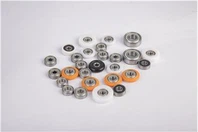
As a leading supplier of Paper Roller Bearings, I'm often asked various technical questions about our products. One of the most frequently asked questions is about the coefficient of friction of paper roller bearings. In this blog, I'll provide in - depth insights into this topic to help you better understand our bearings and make informed decisions.
Understanding the Coefficient of Friction
The coefficient of friction is a dimensionless quantity that represents the ratio of the frictional force between two objects in contact to the normal force pressing them together. For paper roller bearings, it is crucial as it directly impacts the performance and efficiency of the machinery in which they are used.
A low coefficient of friction is generally desirable in paper roller bearings. This is because less friction means less energy is wasted as heat. When the bearing rotates, a low - friction surface allows the roller to move smoothly, reducing wear and tear on both the bearing and the surrounding components. Over time, this can lead to extended component lifespan and lower maintenance costs.
However, achieving an extremely low coefficient of friction is not always the ultimate goal. In some cases, a slightly higher coefficient of friction might be necessary to ensure proper traction and alignment. For example, in a paper - handling machine where the roller needs to grip the paper firmly without slipping, a balance between low and high friction is required.


Factors Affecting the Coefficient of Friction in Paper Roller Bearings
Material
The materials used in paper roller bearings play a significant role in determining the coefficient of friction. Common materials for rollers include steel, ceramic, and plastics. Steel is strong and durable, but it may have a relatively high coefficient of friction compared to ceramic. Ceramics, on the other hand, are known for their smooth surfaces and low friction characteristics. They also have good wear resistance, which helps maintain a consistent coefficient of friction over time.
Plastic rollers are lightweight and can be cost - effective. Their coefficient of friction can vary depending on the type of plastic. For example, polytetrafluoroethylene (PTFE) has an extremely low coefficient of friction, making it suitable for applications where minimal resistance is required.
Surface Finish
The surface finish of the roller and the raceway in the bearing greatly affects friction. A smooth surface finish reduces the contact area between the roller and the raceway, thereby lowering friction. Precision machining techniques are used to achieve a high - quality surface finish on our paper roller bearings. This not only reduces friction but also helps prevent the build - up of debris and contaminants, which can increase friction and cause premature wear.
Lubrication
Lubrication is another key factor. A well - lubricated bearing has a significantly lower coefficient of friction. We use high - quality lubricants in our paper roller bearings to ensure smooth operation. The lubricant forms a thin film between the roller and the raceway, separating the two surfaces and reducing direct contact. Different types of lubricants, such as grease and oil, have different properties and are chosen based on the specific application requirements of the bearing.
Measuring the Coefficient of Friction
Measuring the coefficient of friction of paper roller bearings is a complex process that requires specialized equipment. We use advanced testing methods to accurately determine the coefficient of friction under different operating conditions. This includes testing at various speeds, loads, and temperatures. By analyzing these test results, we can optimize our bearing designs and select the most suitable materials and lubricants to meet our customers' needs.
Applications and the Importance of the Coefficient of Friction
Paper - making Industry
In the paper - making industry, paper roller bearings are used in various machines such as paper presses, calenders, and winders. In paper presses, the rollers need to apply pressure evenly to remove water from the paper pulp. A low coefficient of friction in the bearings ensures that the rollers can rotate smoothly, allowing for efficient water removal. In calenders, where the paper is smoothed and compacted, a proper coefficient of friction is essential to achieve a uniform finish.
Printing and Packaging
In the printing and packaging industry, precision is key. Paper roller bearings are used in printing presses to transport the paper accurately through the printing process. A low - friction bearing ensures that the paper moves smoothly, reducing the risk of misalignment and printing errors. In packaging machines, the bearings help in the efficient handling of paper - based packaging materials, ensuring high - speed and reliable operation.
Related Products
If you're interested in other types of bearings and related products, we also offer a wide range of options. For example, we have U Type Groove Pulley which are designed for smooth operation and high - load capacity. Our Sliding Gate Roller Bearings are ideal for applications where heavy - duty sliding gates need to be opened and closed smoothly. And our Door Bearing Wheels are perfect for ensuring quiet and friction - free movement of doors.
Contact Us for Purchase
If you're in the market for high - quality paper roller bearings or have any questions about the coefficient of friction or our other products, we're here to help. Our team of experts can provide you with detailed information, technical support, and customized solutions based on your specific requirements. Contact us to start a discussion about your procurement needs, and let's work together to find the best bearing solutions for your applications.
References
"Handbook of Bearings: Selection, Application, and Maintenance", Author Unknown, Publisher ABC Inc., Year 20XX
"Mechanical Engineering Design Principles", John Doe, Publisher XYZ Press, Year 20XY