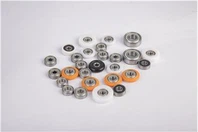
As a supplier of Small Bearings, I've had the privilege of working closely with these precision components for many years. Small bearings play a crucial role in a wide range of applications, from small household appliances to high - tech medical devices. In this blog, I'll introduce you to the various types of small bearings and their unique features.
Ball Bearings
Ball bearings are one of the most common types of small bearings. They use balls to separate two moving parts and reduce friction. The simple yet effective design allows for high - speed operation and relatively low power consumption.
Deep Groove Ball Bearings
Deep groove ball bearings are the most widely used type of small ball bearings. They can handle both radial and axial loads, making them suitable for a variety of applications. For example, in electric motors, they support the rotating shaft and ensure smooth operation. The deep groove design provides excellent guidance for the balls, which helps in maintaining high - speed stability. You can find more information about our high - quality small deep groove ball bearings on our Small Bearings page.
Angular Contact Ball Bearings
Angular contact ball bearings are designed to handle combined radial and axial loads in a specific direction. The contact angle between the balls and the raceways determines the bearing's ability to handle axial loads. These bearings are commonly used in machine tool spindles, automotive transmissions, and other applications where precise axial positioning is required.
Thrust Ball Bearings
Thrust ball bearings are mainly used to handle axial loads. They consist of two washers and a set of balls. These bearings are often found in applications such as automotive steering systems, where they support the axial forces generated during steering.
Roller Bearings
Roller bearings use cylinders or cones instead of balls to reduce friction. They are generally capable of handling heavier loads than ball bearings.
Cylindrical Roller Bearings
Cylindrical roller bearings have a high radial load - carrying capacity. The cylindrical rollers have a large contact area with the raceways, which allows them to distribute the load evenly. They are commonly used in heavy - duty applications such as industrial machinery, railway axles, etc.
Tapered Roller Bearings
Tapered roller bearings can handle both radial and axial loads. The tapered shape of the rollers allows them to align properly under load, which results in efficient load distribution. These bearings are widely used in automotive wheel hubs, where they support the vehicle's weight and handle the forces generated during driving.
Needle Roller Bearings
Needle roller bearings have long, thin rollers, which are called needles. They are suitable for applications with limited radial space but require high load - carrying capacity. For example, in automotive engines, needle roller bearings are used in the connecting rod and camshaft applications.
Spherical Bearings
Spherical bearings are designed to accommodate misalignment between the shaft and the housing. They have a spherical outer ring raceway and a corresponding inner ring. This design allows the bearing to self - align, which is beneficial in applications where there is some degree of shaft deflection or misalignment. Spherical bearings are commonly used in construction machinery, agricultural equipment, and aerospace applications.


Plain Bearings
Plain bearings, also known as bushings, are the simplest type of bearings. They consist of a sleeve or a flat surface that provides a low - friction interface between two moving parts. Plain bearings are often used in applications where the speed is relatively low and the load is not too heavy. They are also cost - effective and easy to install. Examples of applications include door hinges, small pumps, and toy mechanisms.
Specialized Small Bearings
In addition to the above - mentioned common types, there are also some specialized small bearings designed for specific applications.
Ceramic Bearings
Ceramic bearings use ceramic balls or races instead of steel. Ceramic materials have several advantages, such as high hardness, low density, and excellent corrosion resistance. These bearings are often used in high - speed and high - temperature applications, such as in some high - end computer cooling fans and racing engines.
Magnetic Bearings
Magnetic bearings use magnetic fields to support the rotating shaft without any physical contact. This eliminates friction and wear, resulting in extremely high - speed operation and long service life. Magnetic bearings are used in applications such as turbo - compressors, high - speed centrifuges, and some aerospace components.
Case Studies of Small Bearings in Use
Let's take a look at some real - world examples of how these small bearings are used.
In a small - scale 3D printer, deep groove ball bearings are used in the extruder's motor shaft. The smooth rotation provided by these bearings ensures precise filament feeding, which is crucial for high - quality 3D printing.
In a portable power drill, angular contact ball bearings are employed in the chuck mechanism. They can handle the combined radial and axial forces generated during drilling, allowing for efficient and accurate drilling operations.
If you are interested in specific small bearings, like Bearing 6001ZZ or Bearing 6200, you can click on the links to learn more about their specifications and applications.
Conclusion
The world of small bearings is diverse and full of innovation. Each type of small bearing has its own unique characteristics and applications. Whether you are in the manufacturing industry, the automotive sector, or any other field that requires precision components, choosing the right small bearing is crucial for the performance and reliability of your equipment.
As a professional Small Bearings supplier, we have a wide range of high - quality small bearings to meet your various needs. If you are looking for small bearings for your project or application, we are here to help. We can provide you with detailed technical support and guidance to ensure that you select the most suitable bearings. Please feel free to contact us for procurement and further discussions. We are committed to providing you with the best products and services.
References
- "Rolling Bearing Analysis" by Tedric A. Harris
- "Handbook of Bearings" by A. Palmgren
- Industry - specific technical manuals and standards related to bearing applications.