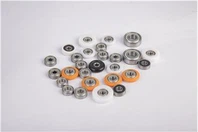
One-way bearings, also known as freewheel clutches, are mechanical devices that allow rotation in one direction while preventing it in the opposite direction. These bearings have a wide range of applications across various industries, offering several significant advantages. As a supplier of one-way bearings, I have witnessed firsthand how these components enhance the performance and functionality of many systems. In this blog post, I will delve into the key advantages of one-way bearings and explain why they are a crucial choice for many engineering applications.
1. Overrunning Functionality
One of the most prominent advantages of one-way bearings is their overrunning capability. This feature enables the driven shaft to rotate freely in one direction when the driving shaft stops or slows down. For example, in a bicycle, the one-way bearing allows the wheels to continue rotating forward even when the rider stops pedaling. This overrunning function is not only convenient but also essential in many industrial applications where continuous motion in one direction is required without the need for constant power input. It helps to reduce wear and tear on the driving mechanism and improves the overall efficiency of the system.
In conveyor systems, Bearing Roller Conveyor often utilize one-way bearings to allow the rollers to rotate freely in the direction of material flow. If there is a sudden stop or reverse movement in the conveyor, the one-way bearings prevent the rollers from rotating backward, ensuring that the materials on the conveyor do not move in the wrong direction. This helps to maintain the integrity of the production process and reduces the risk of damage to the conveyed materials.
2. Backstopping Function
One-way bearings also provide a backstopping function, which is crucial in applications where preventing reverse rotation is necessary. In industries such as mining, construction, and power generation, equipment like elevators, hoists, and conveyors often require backstopping to ensure safety and prevent damage. A one-way bearing can act as a mechanical brake, preventing the driven shaft from rotating in the reverse direction when the power is cut off or when there is a sudden load change.
For instance, in a vertical conveyor system, a one-way bearing can prevent the conveyor from falling backward if there is a power failure. This backstopping function is essential for protecting the equipment and the operators. Similarly, in a wind turbine, one-way bearings are used to prevent the blades from rotating in the wrong direction during high winds or when the turbine is being shut down, which helps to protect the turbine from damage.
3. Simplified Design and Reduced Complexity
Using one-way bearings can simplify the design of mechanical systems. Instead of using complex and expensive braking or clutching mechanisms to achieve the same functions, a single one-way bearing can be used. This not only reduces the number of components in the system but also decreases the overall weight and size of the equipment.
In automotive applications, one-way bearings are used in starters to engage the engine's flywheel only when the starter motor is running. Once the engine starts, the one-way bearing allows the starter motor to disengage automatically, preventing the starter from being driven by the engine. This simple and efficient design eliminates the need for a separate clutch mechanism, reducing the cost and complexity of the starter system.
4. High Torque Transmission
One-way bearings are capable of transmitting high torque in the forward direction. They are designed to handle heavy loads and high rotational speeds, making them suitable for demanding industrial applications. The unique design of one-way bearings allows them to engage and transmit torque smoothly, ensuring reliable operation even under extreme conditions.
In heavy machinery such as crushers and mills, one-way bearings are used to transmit high torque from the motor to the rotating components. The ability to handle high torque ensures that the machinery can operate efficiently and effectively, even when processing large quantities of materials.
5. Low Maintenance Requirements
One-way bearings are relatively simple in design and have fewer moving parts compared to other types of mechanical devices. This results in lower maintenance requirements and longer service life. They are often designed with self-lubricating features or can be easily lubricated, which helps to reduce friction and wear.
In addition, one-way bearings are generally more resistant to shock and vibration, which further contributes to their durability. This means that they require less frequent inspection and replacement, resulting in lower maintenance costs for the end-users.
6. Versatility
One-way bearings come in a variety of sizes, designs, and materials, making them suitable for a wide range of applications. Whether it is a small-scale electronic device or a large industrial machine, there is a one-way bearing that can meet the specific requirements.
For example, Miniature Ball Bearing 699ZZ are used in precision instruments and small motors, where space is limited, and high precision is required. On the other hand, larger one-way bearings are used in heavy machinery and industrial equipment, where high load capacity and durability are essential.


7. Cost-Effectiveness
When considering the overall cost of a mechanical system, one-way bearings offer significant cost savings. Their ability to simplify the design, reduce maintenance requirements, and improve efficiency makes them a cost-effective solution in the long run. Although the initial cost of a one-way bearing may be slightly higher than some other components, the savings in terms of reduced maintenance, increased productivity, and longer service life more than compensate for the upfront investment.
In summary, one-way bearings offer numerous advantages, including overrunning functionality, backstopping, simplified design, high torque transmission, low maintenance requirements, versatility, and cost-effectiveness. These benefits make them an essential component in many industries, from automotive and aerospace to manufacturing and power generation.
If you are in need of high-quality one-way bearings for your application, I invite you to contact us for a detailed discussion. Our team of experts can help you select the right one-way bearing based on your specific requirements. We are committed to providing excellent products and services to meet your needs.
References
- Harris, T. A., & Kotzalas, M. N. (2007). Rolling Bearing Analysis. John Wiley & Sons.
- Zaretsky, E. V. (2010). Ball and Roller Bearing Engineering. CRC Press.
- Society of Tribologists and Lubrication Engineers. (2015). Handbook of Lubrication and Tribology, Volume II: Application and Design. CRC Press.