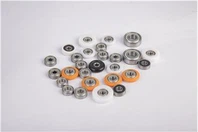
A track bearing roller, a crucial component in various industrial applications, plays a significant role in facilitating smooth and efficient movement. As a supplier of Track Bearing Rollers, I am excited to delve into the intricacies of how these remarkable devices work.
Basic Structure of a Track Bearing Roller
Before we explore how a track bearing roller operates, it's essential to understand its basic structure. A typical track bearing roller consists of an outer ring, an inner ring, rolling elements (usually balls or rollers), and a cage to maintain the proper spacing between the rolling elements. The outer ring is designed to come into direct contact with the track, while the inner ring is often mounted on a shaft.
The rolling elements are the heart of the track bearing roller. They are responsible for reducing friction between the inner and outer rings, allowing for smooth rotation. The cage ensures that the rolling elements are evenly distributed and prevents them from colliding with each other, which could lead to premature wear and failure.
The Working Principle of a Track Bearing Roller
The operation of a track bearing roller is based on the principle of rolling friction. When a load is applied to the track bearing roller, the rolling elements between the inner and outer rings start to roll. This rolling motion significantly reduces the friction compared to sliding friction, which would occur if the two surfaces were in direct contact without the rolling elements.
Let's take a closer look at the process. When a force is exerted on the inner ring, it tries to move relative to the outer ring. However, instead of sliding over the outer ring, the rolling elements roll between the two rings. This rolling action distributes the load evenly across the rolling elements, minimizing the stress on any single point. As a result, the track bearing roller can support heavy loads while maintaining smooth operation.
The track on which the track bearing roller moves is typically designed with a specific profile to ensure proper contact with the outer ring. The shape of the track can vary depending on the application, but it is usually optimized to provide maximum support and stability. For example, in some applications, the track may have a V-shaped profile to guide the track bearing roller and prevent it from deviating from its intended path.
Applications of Track Bearing Rollers
Track bearing rollers are used in a wide range of industries and applications. One of the most common applications is in conveyor systems. In a conveyor system, track bearing rollers are used to support and guide the conveyor belt, ensuring that it moves smoothly and efficiently. The ability of track bearing rollers to handle heavy loads and operate in harsh environments makes them ideal for this application.
Another important application is in construction equipment. Track bearing rollers are used in excavators, bulldozers, and other heavy machinery to support the tracks and allow the equipment to move smoothly over rough terrain. The durability and reliability of track bearing rollers are crucial in these applications, as they need to withstand the high loads and extreme conditions encountered in construction sites.
Track bearing rollers are also used in automotive applications, such as in the suspension systems of cars and trucks. In these applications, track bearing rollers help to reduce friction and improve the ride quality by providing smooth movement between the different components of the suspension system.


Factors Affecting the Performance of Track Bearing Rollers
Several factors can affect the performance of track bearing rollers. One of the most important factors is the quality of the materials used in their construction. High-quality materials, such as high-grade steel, can provide better durability and resistance to wear and corrosion. Additionally, the manufacturing process also plays a crucial role in determining the performance of track bearing rollers. Precise machining and assembly techniques ensure that the rolling elements are properly aligned and that the inner and outer rings have the correct dimensions.
The operating conditions also have a significant impact on the performance of track bearing rollers. Factors such as temperature, humidity, and the presence of contaminants can all affect the lubrication and wear characteristics of the track bearing roller. For example, in high-temperature environments, the lubricant may break down more quickly, leading to increased friction and wear. Therefore, it is important to choose the right lubricant and to take appropriate measures to protect the track bearing roller from harsh operating conditions.
Maintenance of Track Bearing Rollers
Proper maintenance is essential to ensure the long-term performance and reliability of track bearing rollers. Regular inspection and lubrication are two of the most important maintenance tasks. During an inspection, it is important to check for signs of wear, such as cracks, pitting, or excessive clearance between the inner and outer rings. If any signs of wear are detected, the track bearing roller should be replaced immediately to prevent further damage.
Lubrication is also crucial to reduce friction and wear and to protect the track bearing roller from corrosion. The type of lubricant used depends on the application and the operating conditions. In general, it is recommended to use a high-quality lubricant that is specifically designed for track bearing rollers. The lubricant should be applied at regular intervals to ensure that the rolling elements are properly lubricated.
Why Choose Our Track Bearing Rollers
As a supplier of Track Bearing Rollers, we are committed to providing high-quality products that meet the needs of our customers. Our track bearing rollers are manufactured using the latest technology and the highest quality materials, ensuring superior performance and reliability. We offer a wide range of track bearing rollers to suit different applications and requirements, and our experienced team can provide customized solutions to meet your specific needs.
In addition to our high-quality products, we also provide excellent customer service. Our team of experts is available to answer your questions and to provide technical support whenever you need it. We understand the importance of timely delivery, and we strive to ensure that your orders are processed and shipped as quickly as possible.
If you are looking for a reliable supplier of Track Bearing Rollers, look no further. Visit our website Track Bearing Roller to learn more about our products and to place an order. We look forward to working with you and to helping you find the perfect track bearing roller for your application.
References
- "Bearing Handbook" by SKF
- "Mechanical Engineering Design" by Joseph E. Shigley and Charles R. Mischke
- Industry standards and technical literature related to track bearing rollers