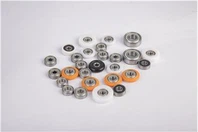
As a trusted supplier of Door Bearing Wheels, I've encountered numerous inquiries regarding the most suitable lubricants for these essential components. The right lubricant can significantly enhance the performance, longevity, and efficiency of door bearing wheels, ensuring smooth operation and minimizing wear and tear. In this blog post, I'll delve into the various types of lubricants available and guide you on selecting the best one for your specific needs.
Understanding the Role of Lubricants in Door Bearing Wheels
Before we explore the different types of lubricants, it's crucial to understand their fundamental role in door bearing wheels. Lubricants serve several key functions:
- Reducing Friction: Friction is the enemy of smooth operation. By applying a lubricant, we can minimize the friction between the moving parts of the bearing wheel, allowing it to rotate freely and effortlessly.
- Preventing Wear and Tear: Friction can cause excessive wear and tear on the bearing surfaces, leading to premature failure. A good lubricant forms a protective film that shields the surfaces from direct contact, reducing the risk of damage.
- Corrosion Protection: Door bearing wheels are often exposed to moisture and other environmental factors that can cause corrosion. Lubricants can act as a barrier, preventing rust and corrosion from forming on the metal components.
- Noise Reduction: Friction and wear can generate noise during operation. A properly lubricated bearing wheel will operate more quietly, providing a more comfortable and peaceful environment.
Types of Lubricants for Door Bearing Wheels
There are several types of lubricants available, each with its own unique properties and applications. Here are the most common types used for door bearing wheels:
Greases
Greases are a popular choice for door bearing wheels due to their high viscosity and ability to stay in place. They consist of a base oil thickened with a soap or other thickening agent, which gives them a semi-solid consistency. Greases offer excellent lubrication and protection, making them suitable for a wide range of applications.
- Lithium Grease: Lithium grease is one of the most widely used greases for door bearing wheels. It has good thermal stability, water resistance, and anti-wear properties. Lithium grease is suitable for both indoor and outdoor applications and can withstand a wide range of temperatures.
- Synthetic Grease: Synthetic greases are formulated using synthetic base oils, which offer superior performance compared to conventional mineral oils. They have better oxidation resistance, lower volatility, and higher temperature capabilities. Synthetic greases are ideal for high-speed or high-temperature applications.
- Food-Grade Grease: In applications where there is a risk of contact with food or beverages, such as in commercial kitchens or food processing facilities, food-grade grease is required. Food-grade greases are formulated to meet strict safety and hygiene standards and are non-toxic and odorless.
Oils
Oils are another option for lubricating door bearing wheels. They have a lower viscosity than greases, which allows them to flow more easily and penetrate into tight spaces. Oils are typically used in applications where high-speed operation or low friction is required.
- Mineral Oil: Mineral oil is a common type of oil used for lubrication. It is derived from crude oil and has good lubricating properties. Mineral oil is relatively inexpensive and widely available, making it a popular choice for general-purpose applications.
- Synthetic Oil: Synthetic oils are formulated using synthetic base oils, which offer superior performance compared to conventional mineral oils. They have better oxidation resistance, lower volatility, and higher temperature capabilities. Synthetic oils are ideal for high-speed or high-temperature applications.
- Silicone Oil: Silicone oil is a type of synthetic oil that has excellent water resistance and low surface tension. It is often used in applications where there is a risk of water exposure, such as in outdoor doors or in areas with high humidity.
Dry Lubricants
Dry lubricants are a unique type of lubricant that do not contain any liquid components. They are typically made from solid materials, such as graphite or molybdenum disulfide, which form a thin, dry film on the surfaces of the bearing wheel. Dry lubricants offer several advantages, including low friction, high temperature resistance, and the ability to operate in dusty or dirty environments.
- Graphite Lubricant: Graphite lubricant is a popular dry lubricant that is made from graphite powder. It has excellent lubricating properties and can withstand high temperatures. Graphite lubricant is suitable for applications where there is a risk of high temperatures or where a dry lubricant is preferred.
- Molybdenum Disulfide Lubricant: Molybdenum disulfide lubricant is another type of dry lubricant that is made from molybdenum disulfide powder. It has excellent lubricating properties and can withstand high pressures and temperatures. Molybdenum disulfide lubricant is suitable for applications where there is a risk of high pressures or where a dry lubricant is preferred.
Factors to Consider When Choosing a Lubricant
When choosing a lubricant for your door bearing wheels, there are several factors to consider:
- Operating Conditions: The operating conditions of the door bearing wheels, such as temperature, humidity, and load, will determine the type of lubricant that is most suitable. For example, in high-temperature applications, a synthetic grease or oil with high thermal stability may be required.
- Bearing Type: Different types of bearings have different lubrication requirements. For example, ball bearings require a lubricant with good anti-wear properties, while roller bearings may require a lubricant with higher viscosity.
- Environmental Factors: The environmental factors to which the door bearing wheels are exposed, such as moisture, dust, and chemicals, will also affect the choice of lubricant. For example, in outdoor applications, a lubricant with good water resistance and corrosion protection may be required.
- Application Requirements: The specific requirements of the application, such as noise reduction, speed, and load capacity, will also influence the choice of lubricant. For example, in applications where noise reduction is important, a lubricant with good damping properties may be preferred.
Recommended Lubricants for Specific Applications
Here are some recommended lubricants for specific types of door bearing wheels:
Garage Door Rollers
Garage door rollers are exposed to a wide range of environmental conditions, including moisture, dust, and temperature variations. They also require a lubricant that can withstand high loads and provide long-lasting protection.
- Lithium Grease: Lithium grease is a good choice for garage door rollers due to its high viscosity, water resistance, and anti-wear properties. It can provide long-lasting lubrication and protection, even in harsh environments.
- Synthetic Grease: Synthetic grease is another option for garage door rollers. It offers superior performance compared to conventional lithium grease, with better thermal stability, oxidation resistance, and water resistance. Synthetic grease is ideal for high-speed or high-temperature applications.
You can find suitable 6200zz Garage Door Rollers on our website.
Sliding Gate Roller Bearings
Sliding gate roller bearings are subject to heavy loads and require a lubricant that can provide excellent lubrication and protection. They are also exposed to outdoor conditions, so the lubricant should have good water resistance and corrosion protection.
- Synthetic Grease: Synthetic grease is a recommended choice for sliding gate roller bearings. It has high load-carrying capacity, good water resistance, and excellent anti-wear properties. Synthetic grease can provide long-lasting lubrication and protection, even in harsh outdoor environments.
- Molybdenum Disulfide Grease: Molybdenum disulfide grease is another option for sliding gate roller bearings. It has excellent lubricating properties and can withstand high pressures and temperatures. Molybdenum disulfide grease is suitable for applications where there is a risk of high pressures or where a dry lubricant is preferred.
Check out our Sliding Gate Roller Bearings for more details.
Paper Roller Bearings
Paper roller bearings are used in the paper industry and require a lubricant that is compatible with paper and does not leave any residue. They also require a lubricant that can provide smooth operation and prevent wear and tear.


- Food-Grade Grease: Food-grade grease is a recommended choice for paper roller bearings. It is formulated to meet strict safety and hygiene standards and is non-toxic and odorless. Food-grade grease can provide smooth operation and prevent wear and tear, without leaving any residue on the paper.
- Silicone Oil: Silicone oil is another option for paper roller bearings. It has excellent water resistance and low surface tension, making it suitable for applications where there is a risk of water exposure. Silicone oil can also provide smooth operation and prevent wear and tear, without leaving any residue on the paper.
Explore our Paper Roller Bearing products for your specific needs.
Conclusion
Choosing the right lubricant for your door bearing wheels is essential for ensuring smooth operation, longevity, and performance. By considering the operating conditions, bearing type, environmental factors, and application requirements, you can select the lubricant that is best suited for your specific needs. Whether you need a grease, oil, or dry lubricant, there is a solution available to meet your requirements.
If you have any questions or need further assistance in selecting the right lubricant for your door bearing wheels, please don't hesitate to contact us. We are a leading supplier of Door Bearing Wheels and have extensive experience in providing high-quality products and solutions. Our team of experts is ready to help you find the perfect lubricant for your application.
References
- "Lubrication Fundamentals" by John W. Sutherland
- "Handbook of Lubrication and Tribology, Volume I: Applications" edited by Bhushan Bharat
- "Industrial Lubrication for Maintenance Professionals" by Robert L. Morgan