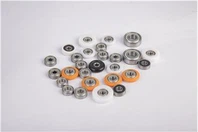
As a supplier of Mini Roller Bearings, I've witnessed firsthand the remarkable evolution of these small yet powerful components. Mini Roller Bearings are integral to countless industries, from aerospace to medical devices, due to their ability to handle high loads with minimal friction in compact spaces. In this blog, I'll explore the future development directions of Mini Roller Bearings, highlighting emerging trends and technologies that are set to shape their role in the global market.
1. Miniaturization and High - Precision Engineering
One of the most prominent trends in the future of Mini Roller Bearings is further miniaturization. As industries such as microelectronics, robotics, and nanotechnology continue to advance, the demand for even smaller bearings with high precision is on the rise. These ultra - small bearings need to offer the same level of performance as their larger counterparts, if not better.
Advancements in manufacturing techniques, such as precision grinding and micro - machining, are enabling the production of Mini Roller Bearings with extremely tight tolerances. For instance, bearings with diameters as small as a few millimeters can now be manufactured with sub - micron precision. This level of accuracy is crucial in applications where space is extremely limited, like in micro - motors used in drones or in the miniature actuators of medical robots.
The development of Micro Roller Bearings is a prime example of this trend. These bearings, designed for the most compact and high - precision applications, are at the forefront of the miniaturization movement. To learn more about Micro Roller Bearings, you can visit Micro Roller Bearings.
2. Enhanced Material and Surface Treatments
The choice of materials and surface treatments plays a vital role in the performance and longevity of Mini Roller Bearings. In the future, we can expect to see the use of advanced materials that offer better mechanical properties, such as higher hardness, improved corrosion resistance, and reduced friction.
Ceramic materials are gaining popularity in Mini Roller Bearing applications. Ceramics like silicon nitride have several advantages over traditional steel bearings. They are lighter, which reduces the overall weight of the system, and they have a higher stiffness, enabling them to handle higher loads. Additionally, ceramics are more resistant to corrosion and can operate at higher temperatures, making them suitable for harsh environments.
Surface treatments are also evolving to improve the performance of Mini Roller Bearings. Coatings such as diamond - like carbon (DLC) can significantly reduce friction and wear, increasing the bearing's lifespan. These coatings can also provide a smooth surface finish, which helps in reducing noise and vibration during operation.
3. Integration with Smart Technologies
The era of the Internet of Things (IoT) is transforming the way Mini Roller Bearings are used and monitored. In the future, Mini Roller Bearings will be increasingly integrated with smart technologies to enable real - time monitoring and predictive maintenance.
Sensors can be embedded in the bearings to collect data on parameters such as temperature, vibration, and load. This data can be transmitted wirelessly to a central monitoring system, where it can be analyzed to detect potential issues before they lead to a failure. For example, an increase in vibration levels could indicate misalignment or wear in the bearing, allowing for timely maintenance to be scheduled.
Predictive maintenance based on real - time data can significantly reduce downtime and maintenance costs. It also helps in optimizing the performance of the entire system by ensuring that the bearings are operating under the best possible conditions.
4. Customization and Application - Specific Design
As industries become more specialized, the demand for customized Mini Roller Bearings is growing. Different applications have unique requirements in terms of load capacity, speed, operating temperature, and environmental conditions. Therefore, future Mini Roller Bearings will be designed to meet these specific needs.
For example, in the automotive industry, bearings used in electric vehicle (EV) powertrains have different requirements compared to those used in traditional internal combustion engines. EV bearings need to operate at high speeds with low noise and vibration, and they also need to be designed to handle the specific loads and torque characteristics of electric motors.
Similarly, in the medical industry, Mini Roller Bearings used in surgical instruments need to be designed for sterilization compatibility and extremely high precision. Our company is committed to providing customized solutions to meet these diverse application requirements. To explore our range of Mini Roller Bearings and discuss customization options, please feel free to reach out.
5. Sustainability and Energy Efficiency
In today's world, sustainability is a key concern for all industries. Mini Roller Bearings are no exception. Future development will focus on reducing energy consumption and environmental impact.
By reducing friction, Mini Roller Bearings can help in saving energy. As mentioned earlier, advanced materials and surface treatments can play a significant role in this regard. For example, bearings with low - friction coatings can reduce the amount of energy required to overcome friction, resulting in lower power consumption.
Recyclability is also an important aspect of sustainability. Future Mini Roller Bearings will be designed with materials that are easier to recycle at the end of their lifespan. This not only reduces waste but also conserves natural resources.
6. Compatibility with High - Speed and High - Frequency Applications
With the increasing demand for high - speed machinery in industries such as manufacturing, aerospace, and telecommunications, Mini Roller Bearings need to be able to operate at higher speeds and frequencies.
To achieve this, new designs and materials are being developed. For example, the 608 Roller Bearing, which is widely used in various applications, is being continuously improved to handle higher speeds. The design of the bearing's internal geometry, such as the shape and size of the rollers and raceways, is optimized to reduce centrifugal forces and improve stability at high speeds. To learn more about the 608 Roller Bearing, visit 608 Roller Bearing.


Conclusion
The future of Mini Roller Bearings is filled with exciting possibilities. From further miniaturization and high - precision engineering to the integration of smart technologies and a focus on sustainability, these components are set to play an even more critical role in various industries.
As a supplier of Mini Roller Bearings, we are dedicated to staying at the forefront of these developments. We invest in research and development to ensure that our products meet the evolving needs of our customers. Whether you are looking for standard Mini Roller Bearings or customized solutions, we have the expertise and resources to provide you with high - quality products.
If you are interested in learning more about our Mini Roller Bearings or have specific requirements for your application, we invite you to contact us for a detailed discussion. Our team of experts is ready to assist you in finding the best bearing solutions for your needs.
References
- "Bearing Technology Handbook" by Peter J. Booser
- "Advanced Materials for Bearings" by John W. Jones
- Industry reports on Miniature Bearings from leading market research firms