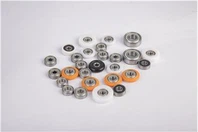
As a supplier of 608 Roller Bearings, I often encounter customers who have questions about the magnetic properties of these bearings. Understanding whether a 608 roller bearing is magnetic is crucial in various applications, especially those where magnetic interference can affect the performance of equipment. In this blog, I'll share some practical methods to test if a 608 roller bearing is magnetic.
Understanding the Basics of 608 Roller Bearings
Before we dive into the testing methods, let's briefly understand what a 608 roller bearing is. The 608 roller bearing is a type of 608 Roller Bearing that belongs to the category of miniature bearings. It has a bore diameter of 8mm, an outer diameter of 22mm, and a width of 7mm. These bearings are widely used in many applications, including skateboards, electric motors, and small machinery due to their compact size and high load - carrying capacity.
The materials used to manufacture 608 roller bearings can vary. Common materials include chrome steel, stainless steel, and ceramic. Chrome steel bearings are usually magnetic, while some types of stainless steel bearings may or may not be magnetic depending on their composition. Ceramic bearings are typically non - magnetic.
Simple Visual Inspection
The first step in determining if a 608 roller bearing is magnetic is a simple visual inspection. If the bearing has a shiny, silver - like appearance, it might be made of stainless steel. However, this is not a definitive way to tell if it's magnetic. Some stainless steels, such as austenitic stainless steels, are non - magnetic, while ferritic and martensitic stainless steels are magnetic. Chrome steel bearings usually have a more dull finish compared to stainless steel ones.
Using a Magnet
The most straightforward method to test the magnetic properties of a 608 roller bearing is to use a magnet. You can use a small, handheld magnet, such as a neodymium magnet, which is relatively strong.


- Prepare the magnet: Make sure the magnet is clean and free from any debris. A clean magnet will give more accurate results.
- Approach the bearing: Slowly bring the magnet close to the bearing. Start from a distance of about 1 - 2 centimeters and gradually move it closer.
- Observe the reaction:
- If the bearing is attracted to the magnet, it is magnetic. The strength of the attraction can also give you an idea about the type of material. A strong attraction usually indicates that the bearing is made of chrome steel or a magnetic type of stainless steel.
- If there is no attraction at all, the bearing is likely non - magnetic. This could mean it is made of a non - magnetic stainless steel or ceramic.
Eddy Current Testing
Eddy current testing is a more advanced method that can be used to determine the magnetic properties of a 608 roller bearing, especially in a manufacturing or quality control setting.
- How it works: Eddy current testing involves passing an alternating current through a coil, which creates a magnetic field. When this magnetic field interacts with the bearing, it induces eddy currents in the bearing material. The presence and magnitude of these eddy currents can be measured.
- Interpretation of results:
- In a magnetic bearing, the eddy currents will be affected by the magnetic properties of the material. The testing equipment can detect changes in the electrical conductivity and magnetic permeability of the bearing, which can be used to determine if it is magnetic.
- For non - magnetic bearings, the eddy current response will be different. The equipment can distinguish between magnetic and non - magnetic materials based on the unique eddy current patterns.
Magnetic Particle Inspection
Magnetic particle inspection is another method that is mainly used for detecting surface and near - surface defects in magnetic materials, but it can also be used to confirm the magnetic nature of a 608 roller bearing.
- Procedure:
- First, the bearing is magnetized using a magnetic field. This can be done using a permanent magnet or an electromagnet.
- Then, magnetic particles, usually in the form of a powder or a liquid suspension, are applied to the surface of the bearing.
- Observation:
- If the bearing is magnetic, the magnetic particles will be attracted to the surface of the bearing and will form patterns. This indicates that the bearing is magnetic.
- If no particles are attracted, the bearing is likely non - magnetic.
Importance of Knowing the Magnetic Properties
Understanding whether a 608 roller bearing is magnetic is essential in many applications.
- Electrical and electronic applications: In electronic devices, magnetic bearings can cause interference with sensitive components. For example, in a hard drive, a magnetic bearing could disrupt the magnetic fields used to store data. Non - magnetic bearings are preferred in such applications.
- Food and pharmaceutical industries: In these industries, non - magnetic bearings are often required to prevent contamination. Magnetic particles from a bearing could potentially contaminate the products being processed.
- High - precision machinery: In high - precision machinery, magnetic bearings can cause issues with the accuracy of measurements. Non - magnetic bearings are used to ensure the stability and accuracy of the equipment.
Other Related Miniature Roller Bearings
If you are interested in other types of miniature roller bearings, we also offer Mini Roller Bearings and Micro Roller Bearings. These bearings have different sizes and specifications to meet various application requirements.
Conclusion
Determining whether a 608 roller bearing is magnetic is not overly complicated. Simple methods like using a magnet can give you a quick answer, while more advanced methods such as eddy current testing and magnetic particle inspection can provide more accurate and detailed information.
If you are in the market for 608 roller bearings or other miniature roller bearings, and you have specific requirements regarding magnetic properties, feel free to contact us. We can provide you with bearings that meet your exact needs. Whether you need magnetic or non - magnetic bearings, we have a wide range of options to choose from.
References
- "Bearing Handbook" by SKF
- "Materials Science and Engineering: An Introduction" by William D. Callister, Jr. and David G. Rethwisch