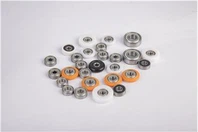
Selecting small bearings for a high - speed spindle can be a tricky task, but don't worry! As a small bearings supplier, I've got some valuable insights to share with you. In this blog, I'll walk you through the key factors you need to consider when making this important decision.
1. Understand the Basics of High - Speed Spindles
First off, let's talk a bit about high - speed spindles. These are used in a wide range of applications, like CNC machines, dental drills, and high - precision grinding tools. They operate at extremely high rotational speeds, sometimes up to tens of thousands of revolutions per minute (RPM). This high - speed operation puts a lot of stress on the bearings, so you need to choose ones that can handle it.
2. Load Requirements
One of the most important things to think about is the load that the bearings will have to support. There are two main types of loads: radial and axial. Radial loads act perpendicular to the axis of rotation, while axial loads act parallel to it.
For high - speed spindles, you need to accurately calculate the expected radial and axial loads. If the load is too high for the bearing, it can lead to premature wear and failure. For example, in a CNC milling machine, the cutting forces generate both radial and axial loads on the spindle bearings. Make sure to consult the machine's manual or do some calculations based on the machining operations to determine the load requirements.
3. Speed Capability
As I mentioned earlier, high - speed spindles run at really fast speeds. So, the bearings you choose must have a high speed rating. The speed rating of a bearing is typically given in RPM and is determined by factors like the bearing's design, material, and lubrication.
When selecting small bearings for a high - speed spindle, look for bearings that are specifically designed for high - speed applications. For instance, Bearing 6001ZZ is a popular choice for many high - speed spindle applications. It has a relatively high speed rating and can handle moderate loads.
4. Precision and Tolerance
Precision is crucial when it comes to high - speed spindles. Even a small amount of misalignment or runout can cause vibrations, noise, and reduced machining accuracy. That's why you need to choose bearings with high precision and tight tolerances.
Bearings are classified according to their precision levels, such as P0, P6, P5, P4, and P2, with P2 being the highest precision. For high - speed spindles, I'd recommend using at least P5 or P4 grade bearings. These bearings have better roundness, concentricity, and surface finish, which helps to ensure smooth operation at high speeds.
5. Lubrication
Proper lubrication is essential for the performance and longevity of high - speed bearings. Lubrication reduces friction, dissipates heat, and protects the bearing surfaces from wear and corrosion.
There are two main types of lubrication for bearings: grease and oil. Grease lubrication is simpler and more cost - effective, but it has limitations in high - speed applications due to heat generation and limited lubricant life. Oil lubrication, on the other hand, can provide better cooling and lubrication at high speeds.
When using oil lubrication, you can choose from different methods such as oil - mist lubrication, oil - jet lubrication, or oil - air lubrication. Each method has its own advantages and disadvantages, so you need to choose the one that best suits your application.
6. Material and Heat Treatment
The material of the bearing and its heat treatment also play a significant role in its performance at high speeds. Most small bearings for high - speed spindles are made of high - quality bearing steel, such as chrome steel or stainless steel.
Chrome steel bearings are strong and have good wear resistance, but they may not be suitable for applications where corrosion is a concern. Stainless steel bearings, on the other hand, offer better corrosion resistance but may have slightly lower load - carrying capacity compared to chrome steel bearings.
The heat treatment of the bearing material affects its hardness, toughness, and dimensional stability. A proper heat - treated bearing can withstand the high stresses and temperatures generated during high - speed operation.


7. Bearing Design
The design of the bearing can also impact its performance in a high - speed spindle. There are different types of small bearings available, such as ball bearings and roller bearings.
Ball bearings are generally better suited for high - speed applications because they have lower friction and can handle both radial and axial loads to some extent. Bearing 6200 is another example of a ball bearing that can be used in high - speed spindles. It has a simple design and is easy to install.
Roller bearings, on the other hand, are better for applications with high radial loads. However, they may not be as suitable for extremely high - speed operation due to their higher friction.
8. Noise and Vibration
High - speed spindles should operate quietly and with minimal vibration. Excessive noise and vibration can not only affect the machining quality but also indicate a problem with the bearings.
When selecting small bearings, look for ones that are designed to reduce noise and vibration. Some bearings have special features, such as optimized internal clearances and improved cage designs, which can help to minimize noise and vibration.
9. Cost - Effectiveness
While it's important to choose high - quality bearings for your high - speed spindle, you also need to consider the cost. There's a wide range of small bearings available at different price points.
Don't always go for the cheapest option, as it may not meet your performance requirements. On the other hand, you don't need to over - spend on bearings that have features you don't actually need. Try to find a balance between performance and cost.
Conclusion
Selecting small bearings for a high - speed spindle is a complex process that requires careful consideration of multiple factors. By understanding the load requirements, speed capability, precision, lubrication, material, design, noise, and cost - effectiveness, you can make an informed decision.
If you're still unsure about which small bearings are right for your high - speed spindle, don't hesitate to reach out. As a Small Bearings supplier, I have the expertise and a wide range of products to help you find the perfect bearings for your application. Contact me for more information and let's start a fruitful discussion about your bearing needs.
References
- Harris, T. A., & Kotzalas, M. N. (2007). Rolling Bearing Analysis. Wiley.
- Zaretsky, E. V. (2010). Ball and Roller Bearing Engineering. CRC Press.