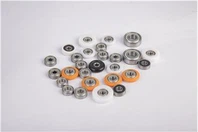
Yo, fellow gearheads and industry peeps! Today, I'm gonna dive deep into a hot topic in the bearing world: how paper roller bearings stack up against ball bearings.


I'm a supplier of paper roller bearings, and I've seen firsthand the unique advantages our products offer. But I also recognize the long - standing popularity of ball bearings. So, let's break it down and see which one might be the better fit for your applications.
Structure and Design
First off, let's talk about the physical makeup of these two types of bearings. Ball bearings, as the name suggests, use spherical balls to reduce friction between moving parts. These balls are typically made of steel, sometimes ceramic, and are housed between inner and outer races. The design allows for point contact between the balls and the races, which distributes the load evenly but also means that the contact area is relatively small.
On the other hand, paper roller bearings are quite different. They use cylindrical rollers made from special paper - based materials. Yeah, you heard me right, paper! These rollers are engineered to be strong, durable, and able to handle different loads. They are also placed between inner and outer races, but the contact between the roller and the races is linear rather than point - based like in ball bearings.
Load - Carrying Capacity
When it comes to load - carrying capacity, both bearings have their own strengths. Ball bearings are great for applications where the load is relatively light to moderate. Because of their point contact, they're very efficient in reducing friction when the load isn't too heavy. For example, in high - speed machinery like electric motors, ball bearings are often the go - to choice. The small contact area reduces rolling resistance, allowing the motor to spin smoothly at high speeds with minimal energy loss.
Paper roller bearings, however, shine when it comes to handling heavy loads. The linear contact between the roller and the races spreads the load over a larger area. This means they can distribute heavy loads more effectively than ball bearings. In industrial settings where heavy machinery is involved, like large manufacturing equipment or conveyor systems, paper roller bearings can take the pressure and keep things running.
Friction and Efficiency
Friction is a major factor in bearing performance. Lower friction means less energy is wasted as heat, which translates to better efficiency and longer - lasting equipment.
Ball bearings have a very low coefficient of friction when operating under normal conditions. The smooth, spherical shape of the balls allows for easy rolling, which is why they're so popular in applications where speed is key. But they can start to face issues when the load gets too high. The small contact area can lead to increased pressure, which in turn can cause more friction and wear.
Paper roller bearings offer a different scenario. While their friction characteristics might not be as low as ball bearings in light - load, high - speed applications, they can maintain good efficiency under heavy loads. The larger contact area of the rollers means that the pressure per unit area is lower, which helps to keep friction in check even when the load is significant.
Noise and Vibration
Noise and vibration are often considered when choosing a bearing for a particular application. Ball bearings are generally quite quiet and smooth - running. The spherical shape of the balls allows for a consistent rolling motion, which minimizes noise and vibration. This is why they're commonly used in consumer products like home appliances and office equipment, where a quiet operation is desired.
Paper roller bearings, on the other hand, can be a bit noisier, especially if they're not properly installed or maintained. However, in industrial settings where noise is less of a concern and the focus is on load - carrying capacity, this might not be a deal - breaker.
Cost
Cost is always a factor when making a purchasing decision. Ball bearings are mass - produced and have been around for a long time, so they're relatively inexpensive in most cases. You can find ball bearings for a wide range of applications at affordable prices.
Paper roller bearings, on the other hand, are often more expensive. The process of manufacturing the special paper - based rollers and ensuring their quality is more complex. But you have to remember, you're paying for the added benefits they offer, such as better load - carrying capacity and durability in certain situations.
Applications
Let's take a look at some specific applications where each type of bearing excels.
Ball bearings are everywhere. You'll find them in cars, in the wheels, transmissions, and various engine components. They're also used in computer hard drives, where the high - speed, low - friction operation is crucial. And don't forget about the Sliding Gate Roller Bearings, which often rely on ball bearings for smooth movement.
Paper roller bearings, on the other hand, are a great choice for heavy - duty industrial applications. They're used in large mining equipment, where the massive loads need to be supported. In addition, they're also used in some construction machinery. And if you're looking at specialized applications like U Type Groove Pulley and Door Bearing Wheels, paper roller bearings can offer unique advantages in terms of load - handling and durability.
Conclusion
So, which one is better, paper roller bearings or ball bearings? Well, it really depends on your specific needs. Ball bearings are great for light - to - moderate load, high - speed applications where low friction, quiet operation, and low cost are priorities. Paper roller bearings, on the other hand, are the champs when it comes to heavy - load applications where durability and load - carrying capacity are more important than a super - quiet operation.
If you're thinking about a bearing upgrade or choosing the right bearing for a new project, and you're curious about what paper roller bearings have to offer, I'm here to help. Just reach out, and we can have a chat about how our paper roller bearings might be the perfect fit for you.
Let's find the best bearing solution together. Whether it's for a small - scale consumer product or a large - scale industrial operation, I'm confident we can find a solution that meets your requirements.
References
- "Bearing Handbook", Industrial Bearing Manufacturers Association
- "Principles of Mechanical Engineering", Various Engineering Textbooks