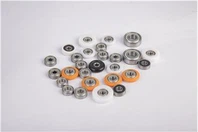
As a supplier of Bearing 6001ZZ, I often encounter inquiries about the suitability of our product for various applications, one of the most common being water - treatment equipment. In this blog post, we will explore whether Bearing 6001ZZ can indeed be used in water - treatment equipment, analyzing the technical characteristics of the bearing and the specific requirements of water - treatment processes.


Technical Specifications of Bearing 6001ZZ
First, let's understand the basic features of Bearing 6001ZZ. This is a deep - groove ball bearing with a double - shielded design (the "ZZ" indicates double metal shields on both sides). The bearing has an inner diameter of 12 mm, an outer diameter of 28 mm, and a width of 8 mm. Being a deep - groove ball bearing, it is designed to handle both radial and axial loads, capable of high - speed operation, and is widely used in various industrial applications.
The double - shielded structure plays a crucial role in protecting the bearing. The shields prevent solid contaminants such as dust and debris from entering the bearing, while also retaining the lubricant inside, which is essential for the long - term operation of the bearing and to reduce friction.
Requirements of Water - Treatment Equipment
Water - treatment equipment encompasses a wide range of machinery, including pumps, mixers, agitators, and filtration systems. Each type of equipment has its own set of requirements for bearings.
- Pumps: In water pumps, bearings are used to support the rotating shaft. The bearing needs to withstand high - speed rotation and radial loads generated by the impeller. Additionally, the bearing may be exposed to water, especially in submersible pumps. Water can cause corrosion, which can reduce the life of the bearing and affect its performance.
- Mixers and Agitators: These devices are used to blend chemicals and water in the treatment process. Bearings in mixers and agitators need to handle both radial and axial loads due to the movement of the mixing blades. Vibration is also a common issue, which requires the bearing to have good shock - resistance.
- Filtration Systems: In filtration equipment, bearings are used to support rotating parts such as filter drums. The requirements for the bearings are relatively less demanding in terms of load and speed compared to pumps and mixers, but they still need to be protected from water and debris.
Suitability Analysis of Bearing 6001ZZ for Water - Treatment Equipment
Advantages
- Size and Precision: The relatively small size of Bearing 6001ZZ makes it suitable for applications where space is limited, which is often the case in some compact water - treatment equipment. Its high - precision manufacturing ensures smooth and stable operation, reducing vibration and noise, which is beneficial for the overall performance of the equipment.
- Load - Handling Capacity: The deep - groove design of the bearing enables it to handle both radial and axial loads effectively. In many water - treatment applications, such as small - scale pumps and mixers, the load - handling capacity of Bearing 6001ZZ is sufficient to meet the requirements.
- Shielded Design: The double - shielded design provides a certain degree of protection against solid contaminants. This can prevent debris from entering the bearing, which is important in water - treatment environments where there may be suspended particles in the water.
Limitations
- Corrosion Resistance: One of the major challenges in water - treatment applications is corrosion. Bearing 6001ZZ is typically made of standard bearing steel, which is not highly resistant to corrosion. If the bearing is directly exposed to water for a long time, especially water with high levels of chemicals or salts, it will corrode quickly. This can lead to pitting on the bearing surfaces, increased friction, and eventually, bearing failure.
- Exposure to Water: Although the double - shielded design can prevent some contaminants from entering the bearing, it is not a waterproof solution. In highly wet environments, such as in submersible pumps, water may still penetrate the shields over time and reach the bearing surfaces, causing damage.
Mitigation Strategies
If you still want to use Bearing 6001ZZ in water - treatment equipment, several mitigation strategies can be employed.
- Sealing Enhancement: In addition to the standard double - shielded design, additional sealing mechanisms can be used. For example, installing rubber seals outside the bearing can provide better protection against water ingress. These seals can be designed to fit the specific requirements of the equipment and the working environment.
- Corrosion - Resistant Coating: Applying a corrosion - resistant coating to the bearing surfaces can significantly improve its resistance to corrosion. Coatings such as zinc - nickel or chrome - based coatings can create a barrier between the bearing steel and the corrosive environment.
- Proper Lubrication: Using high - quality, water - resistant lubricants can also help to extend the life of the bearing. The lubricant not only reduces friction but also provides a layer of protection against corrosion.
Comparison with Other Bearings
It is also useful to compare Bearing 6001ZZ with other bearings commonly used in water - treatment equipment, such as Bearing 6200.
- Size and Load Capacity: Bearing 6200 has a larger inner diameter (10 mm compared to 12 mm for Bearing 6001ZZ), outer diameter (30 mm compared to 28 mm), and width (9 mm compared to 8 mm). This means that Bearing 6200 can generally handle higher loads than Bearing 6001ZZ. However, in applications where space is limited, Bearing 6001ZZ may be a better choice.
- Corrosion Resistance: Both bearings are typically made of standard bearing steel and have similar corrosion - resistance properties. However, if a specific bearing is required for highly corrosive water - treatment environments, special - purpose bearings made of stainless steel or with advanced coatings may be more suitable.
Conclusion
In conclusion, while Bearing 6001ZZ has its advantages in terms of size, load - handling capacity, and protection against solid contaminants, its use in water - treatment equipment is limited by its relatively poor corrosion resistance and non - waterproof design. With proper mitigation strategies such as sealing enhancement, corrosion - resistant coatings, and the use of high - quality lubricants, it can be used in some water - treatment applications, especially in less demanding environments where space is a constraint.
If you are in the water - treatment industry and are considering the use of bearings, we invite you to contact us for further discussion. As a supplier of Small Bearings, including Bearing 6001ZZ, we have the expertise and experience to help you select the most suitable bearing for your specific application. We are ready to work with you to ensure the optimal performance and reliability of your water - treatment equipment.
References
- Harris, T. A., & Kotzalas, M. N. (2007). Rolling Bearing Analysis. John Wiley & Sons.
- Neale, M. J. (1995). Tribology Handbook. Butterworth - Heinemann.